
Can someone copy your game with AI from the demo if you never registered it?
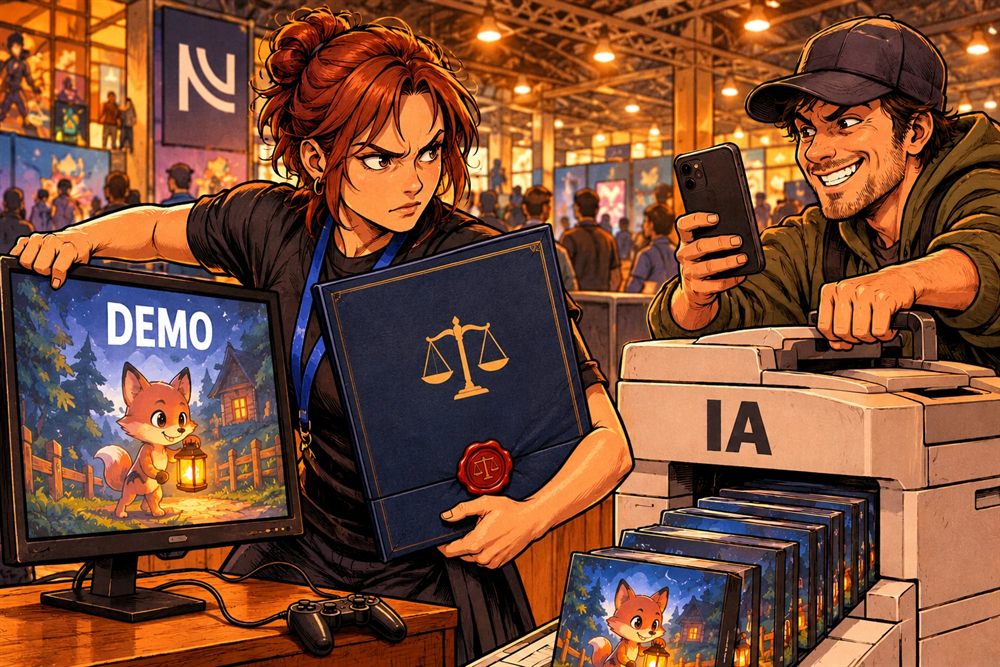
You post a video of your game, it goes viral and within weeks there are more than a dozen near-identical games on Steam, before yours is even out. Cloning a video game no longer takes a team. It takes an AI tool and the demo or trailer you published yourself. The answer to the question in the title has two parts. Your idea and your mechanics can be copied, registered or not. Your code, art, music, characters and name cannot, but you will only stop it if you can prove what was yours and since when. That is what registering your game before you show it is for.
What is happening with AI game clones and Steam demos
On 13 November 2026, GamesIndustry.biz reported on a publisher and investor panel held in London at the AI and Games Conference. James Barnes, of publisher Raw Fury, called it "a wild situation" and said he understood small studios that would rather not show their ideas in case someone beats them to it. Stefan Metaxa, of Spiderling Studios, explained that the traditional wisdom was to announce early and build wishlists over months, and that this "seems to be changing fundamentally". Lirui Ding, of Transcend Fund, said they now advise their studios to pick the right moment for the big announcement rather than making it as early as possible.
This is not a theoretical worry. There are three cases from recent months.
- The needle in the haystack. In August 2026 several clips of Needle in a Haystack Simulator went viral. It is a game still in development where you have to find one needle among five million pieces of hay. According to Kotaku, by mid-October there were at least fourteen clones on Steam with near-identical titles. One of the studios that had released its own version later accused another of copying its code, with thirteen classes that kept the same names and error messages repeated word for word.
- The demo that never came out. Alliance Arts had scheduled the public demo of Drunken Goddess Reflux for 19 October, the same week Steam Next Fest began. It cancelled it days earlier and replaced it with closed sessions. Its explanation, as reported by the specialist press, was that the content of the demo could be used to imitate the game's presentation and gameplay with AI, and that those copies could be released before its own launch.
- The emails asking for money. On 27 October, at a Valve event for developers in Korea, a studio said that emails are arriving that threaten to clone the game with AI and release it first unless the developer pays. According to Inven Global's report, Valve's representative replied that this is a matter for the police, that clones existed before AI and that Steam will not decide which tools each studio uses.
Kotaku also reports the case of a creator who cloned an indie game on Roblox within twenty-four hours, from a single video. And that October Steam Next Fest gathered more than 8,000 demos, roughly double the June edition, according to Time Extension.
Valve's advice to studios was to look after their community and keep updating the game. That is commercial advice. Barnes gave another piece in London that comes closer to the legal side, "You can sell your vision without giving away your blueprint". To do that you first need to know which part of your game is the blueprint.
Is it illegal to copy a game? The idea is free, what you made of it is not
This is the part nobody likes to hear. The idea for a game belongs to no one. Finding a needle in a haystack, surviving on an island or running a card shop are concepts, and anyone can make their own game with them.
Spain's Intellectual Property Act says so for software in Article 96.4, which leaves unprotected the ideas and principles underlying any element of a computer program. The Court of Justice of the European Union confirmed it in 2012, in SAS Institute, when it held that the functionality of a program is not protected by copyright. The same goes for rules and mechanics, as we explain in how far you can protect the board game of your video game.
What is yours is the specific way you turned that idea into a game. The same court said in 2014, in Nintendo v PC Box, that a video game is complex matter comprising a program and also graphic and sound elements with creative value of their own. Each of those pieces is protected if it is original.
The practical difference is large. Someone who makes a needle-finding game with their own code and their own graphics infringes nothing. Someone who decompiles your executable with AI and pastes your functions into their project, or reuses your models and your music, does.
Artificial intelligence has not changed this rule. It has changed the speed. What used to take a team and several months now takes days and a video, and that leaves the original without the advantage of being first.
Which parts of your game are yours and what protects each one
Before registering anything you need to know what you are going to register. The job is to separate what anyone can use from what is only yours, and in a video game what is yours usually sits in five places.
- The code. It is a computer program and, if original, is protected by copyright from the moment it is written. Literal copying is also the easiest to prove, as the thirteen classes with the same names show.
- The art, music, text and characters. Sprites, models, animations, the soundtrack, the script and the dialogue are works, each in its own right. So are the characters, in their drawing and their original characterisation.
- The title and the logo. Article 10.2 of the Act protects an original title as part of the work, but the tool that works is the trade mark. Here the needle case teaches an uncomfortable lesson. A title that merely describes the game with an everyday expression is hard to register, because Article 5.1 of the Spanish Trade Marks Act excludes signs with no distinctive character and signs that only describe the product. A distinctive name, with the trade mark filed before the first trailer, does not stop the clones, but it does stop them being sold under a name that can be confused with yours.
- The look. The appearance of a character, an interface or an icon can be protected as a European Union design. And there is a little-known point that fits demos well. The unregistered design arises on its own, with the first public disclosure in the Union, provided it is new and has individual character, lasts three years and lets you act against anyone who copies it. We explain it in how to protect characters, interfaces and animations with the EU design.
- What you have not shown yet. The levels still to come, internal tools, balance data or the launch plan are trade secrets for as long as they remain secret and the studio has taken reasonable steps to keep them so, which is what Article 1 of the Spanish Trade Secrets Act requires. We cover it in whether a studio can protect the way it works internally.
There is one prior check that many studios skip. To enforce any of these elements they have to belong to the studio, and that depends on the contracts with the people who created them. If the art was made by a freelancer with no signed assignment, the studio cannot register or claim what is not its own, as we explain in who owns the code a contributor without a contract adds to your game.
How to register a video game in Spain and why to do it before you show it
Copyright does not depend on any registry. Article 1 of the Intellectual Property Act says the work belongs to the author by the mere fact of its creation. Registration does not create the right. It is there for the day the right is disputed.
Against a clone, the studio has to prove that the work existed, that it was its own and that it predates the copy. When the clone appears three weeks after a trailer, the date decides almost everything.
The Spanish Intellectual Property Registry gives that proof. Under Article 145.3 of the Act, registered rights are presumed to exist and to belong to their holder unless proven otherwise. In other words, whoever goes to court with the registration does not have to prove authorship. The other side has to rebut it.
A video game is not registered as a single thing. Its pieces are registered.
- The code, as a computer program. The Registry's regulations ask for the full source code and an executable. Many studios are wary of handing over the code, but the same regulations limit public consultation of programs to what appears in the registry entry, so the deposited code is not open to third parties.
- The art, the music and the script, each as the work it is.
- The versions. A game in development changes every month. Article 101 of the Act allows successive versions of the program to be registered too, and it is worth doing so at each milestone you are going to show, whether the demo, the trailer or early access.
The Registry is not the only proof of date, and for day-to-day work there are faster ones. A qualified electronic time stamp on the build or on the repository records the exact content at an exact moment. Article 326.4 of the Spanish Civil Procedure Act presumes that an electronic document backed by a qualified trust service has the characteristic in dispute, and whoever challenges it bears the burden of verification. A notarial deposit and the version control history complete the file.
Timing matters. A registration or a time stamp that predates the trailer makes it very hard to dispute who came first. Those obtained when the clone is already in the store come too late for that.
What none of this evidence does is widen what is protected. Registering the game does not make the mechanics yours. It serves to prove that the code, the art and the name were yours on that date.
Clones that copy nothing literally and unfair competition
A well-made clone copies neither a line of code nor a graphic. It rebuilds the whole game by its own means, or by those of an AI, and keeps the idea. Copyright does not reach that far, and the question becomes whether the imitation is fair.
The Spanish Unfair Competition Act starts from the same freedom. Article 11 says that imitating someone else's products and business initiatives is free, unless they are covered by an exclusive right. However, the same article treats imitation as unfair in two cases that fit what is happening on Steam.
- When it creates association. This happens if players may believe the clone is the original or comes from the same studio. Article 6 adds that the risk of association as to origin is enough for unfair confusion.
- When it takes unfair advantage of someone else's reputation or effort. A clone that lives off the attention the original generated, adding nothing of its own, is in that territory.
At NN Agency we take the view that a clone with a near-identical title to a game that has just gone viral, released within weeks, is the clearest of the two.
It is not an easy route. The Act excludes unfairness when those risks are unavoidable, confusion or unfair advantage must be proven and each case turns on how similar the two games are and how they are presented to the public. But it is the route left when the clone has been careful not to copy anything literally. Evidence rules here too, and it consists of showing what you had published, on what date and with what reach.
Public Steam demo or closed playtest, what changes legally
A public demo is marketing and it is also a handover. Whoever downloads it receives a copy of the program, with part of the code and the assets inside.
Copying, decompiling or redistributing that copy to release another game already infringes the law, and the demo's terms should say so. What is not prohibited is studying how it works. Article 100.3 of the Intellectual Property Act allows the lawful user to observe, study or test the functioning of the program in order to determine its underlying ideas and principles, without the right holder's authorisation. In other words, the demo hands the idea to anyone, lawfully.
A closed playtest changes three things.
- Who gets in. The studio knows who has the copy.
- What they accept. Participants first accept terms, with confidentiality, a ban on recording and publishing and a ban on extracting assets. Alliance Arts has gone down that road, with prior application and acceptance of rules.
- What stays secret. What is shown in confidence to a limited group can remain a trade secret, because the studio has taken steps to protect it. What is published in an open demo no longer is.
Neither option suits everyone. A public demo is still the best way to fill the wishlist, and giving it up has a commercial cost. What changes is the order. Before publishing it, what is original in the game has to be identified, registered and dated, the trade mark filed and the build stripped of anything not needed to play it.
What to do if a clone of your game is already out
The order of the steps matters here as well.
- Secure the evidence before telling anyone. The store page, screenshots, video and the clone's executable, all with a reliable date. Clones disappear and change names.
- Compare piece by piece. Code, assets, text, title and cover art. That shows whether there is copyright, trade mark or design infringement, or only imitation.
- Notify the store. Platforms operating in the European Union are required by Article 16 of the Digital Services Act to provide a mechanism for notifying illegal content. The notice has to be precise and substantiated, and that is where the registration and the comparison carry weight.
- Send a cease and desist to the clone's author and, if it is not withdrawn, sue. The Intellectual Property Act allows you to seek an injunction, withdrawal and damages under Articles 138 and 139. Article 141 allows urgent interim measures also where there is a reasonable and well-founded fear that the infringement is imminent. In other words, there is no need to wait for the clone to be released if it has already been announced.
- Do not pay anyone who threatens you. Demanding money under the threat of cloning the game may be a criminal offence of threats, which Article 171 of the Spanish Criminal Code punishes even when the harm threatened is not itself a crime. Keep the email and report it.
When the clone's author is outside Spain or cannot be identified, the store is the fastest route. That is why it pays to have the evidence ready before you need it.
Protecting your game before the first trailer, a checklist for your studio
At NN Agency we recommend reaching the first public video with this list closed.
- Inventory of what is original. Which pieces of the game are your own, which are common ideas or third-party assets and which were generated by an AI with no creative input from anyone, because there is no copyright to enforce over those.
- Ownership. Contracts with an assignment of rights from everyone who made code, art or music.
- Registration. Code, art and music registered, and each milestone time-stamped.
- Name. A distinctive title, with the trade mark filed before it is announced.
- Look. Consider registering as designs the characters and the interface that identify the game.
- Demo. Decide whether it is public or closed, on what terms and what goes into the build.
- Monitoring. Someone watching the stores in the weeks after each announcement, and a plan to react.
How all this fits into the commercial strategy of a launch is covered in the legal shield behind Atomfall.
Frequently asked questions
▸Is it illegal to copy a game?NPC
▸Is it illegal to copy a game idea?NPC
▸How do you protect a game idea?NPC
▸Can you copyright video game mechanics?NPC
▸How do you copyright a game in Spain?NPC
▸Can a video game be patented?NPC
▸What is a game clone and when is it infringement?NPC
▸What should I do if someone copied my game on Steam?NPC
▸Is a public demo or a closed playtest better?NPC
▸Is a game made with AI protected by copyright?NPC
Sources
- GamesIndustry.biz, An investor and publisher perspective on the rise of AI copycats, 13 November 2026
- Kotaku, Devs Of Needle In A Haystack Clone Angry It's Been Cloned By AI, 18 October 2026
- Dexerto, Developer cancels demo over fears people could use AI to copy game before launch, 17 October 2026
- Inven Global, Developers Fear AI Slop and Clones, Valve Answers Directly, 27 October 2026
- Time Extension, Steam Next Fest Under Fire as Demo Festival Drowns in a Flood of AI Slop, 21 October 2026
- Spanish Intellectual Property Act, Articles 1, 5, 10, 96, 100, 101, 138, 139, 141 and 145, BOE, consolidated text
- Regulations of the General Intellectual Property Registry, Royal Decree 281/2003, Articles 14 and 32, BOE
- Act 3/1991 on Unfair Competition, Articles 6 and 11, BOE, consolidated text
- Act 1/2019 on Trade Secrets, Article 1, BOE
- Act 17/2001 on Trade Marks, Article 5, BOE, consolidated text
- Spanish Civil Procedure Act, Article 326, BOE, consolidated text
- Spanish Criminal Code, Article 171, BOE, consolidated text
- Court of Justice judgment of 2 May 2012, SAS Institute, Case C-406/10, EUR-Lex
- Court of Justice judgment of 23 January 2014, Nintendo, Case C-355/12, EUR-Lex
- Regulation (EU) 2022/2065, Digital Services Act, Article 16, EUR-Lex
At NN Agency, as video game lawyers, we help studios identify and register what makes their game original, from the code to the trade mark, close the contracts with the people who create it and react when a clone appears. If you are about to show your game for the first time or a copy is already out, let's talk before the next step. The first consultation is free.
Facing something similar at your studio? The first consultation is free.
Free consultation