
How far can you protect the board game based on your video game?
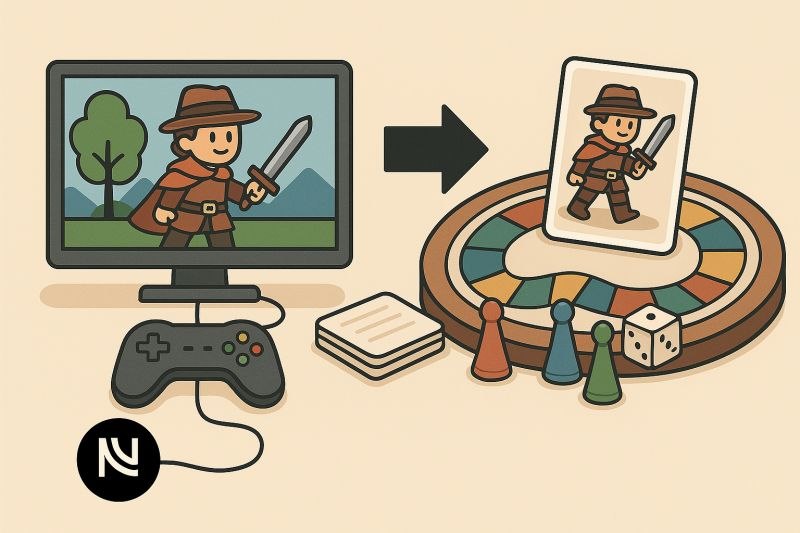
Several clients in video game development have brought us the same concern on different occasions: how to legally protect a product derived from their original work, and specifically what happens when the universe, characters or narrative of their video game are turned into a board game (or the other way round). The key question is how far that physical product is covered by the video game's rights, and the answer requires understanding first the principle that orders all of copyright law: expression is protected, never the idea.
The starting point: derivative work
From a legal standpoint, when a board game is created from a video game it qualifies as a derivative work. Article 11 of the Spanish Intellectual Property Act recognises that derivative works (adaptations, transformations or translations of a pre-existing work) are equally protected.
That means the board game does not start from zero: it is regarded as a transformation of the parent work, and it inherits and extends the legal protection granted to the video game.
With one prior condition, though, which is where most projects break: that the ownership of the rights over the original work allows it. Either because the owner retains them in full, or because the licences or assignments enabling the creation and exploitation of the derivative have been obtained. Transformation is an exclusive right of the video game's owner: if the studio once assigned transformation or merchandising rights to a publisher, it may find that it cannot make the board game of its own universe. That is the first thing we review, before talking about boards.
And the analysis works the same in reverse: if what you want is to turn a board game into a video game, transformation is an exclusive right of the board game's owner, and you need their licence before writing the first line of code. The direction of the jump changes; the legal reasoning does not.
The principle that orders everything: idea versus expression
The protection of the board game born from your video game finds its limits and its possibilities in a key principle of copyright: only the concrete form of expression of an idea is protectable, not the idea itself.
Both Spanish law and the applicable international treaties (the Berne Convention and the European Union framework) exclude from protection ideas, methods, systems, procedures and game rules as abstract concepts.
The direct consequence: the rules, dynamics and mechanics that structure a board game fall outside copyright. Nobody can claim exclusivity over the procedure of rolling dice, accumulating points, advancing squares or trading cards, however innovative the combination. Legally they are ideas or methods of operation, and ideas belong to no one.
A board game is made up of rules and mechanics, a board, pawns, cards and illustrations, a narrative or thematic universe, and an instruction manual. Of all that, the system stays out and the expression stays in. The whole legal strategy consists of knowing what sits on each side of that line.
Which elements are protected
The exclusion of mechanics does not leave the game unprotected. On the contrary: copyright protects the expressive elements that shape its concrete appearance, provided they meet two essential requirements: originality (reflecting the author's creative imprint) and concrete expression (not remaining on the abstract plane).
In a board game derived from a video game, that covers two layers:
The one inherited from the video game: the narrative, graphic and visual elements that already form part of the pre-existing work. The characters, the universe, the story, the aesthetics. Their use in the board game is an authorised reuse of the original intellectual property.
The new one: the texts of the manual and the cards, the lore written for the occasion, the illustrations of the board and the pawns, and the creative arrangement of the whole on a different physical medium, provided that adaptation involves an additional creative effort beyond mere mechanical reproduction. The concrete, original combination of all the elements can also be protected as a whole.
What stays out, however much it hurts
And on the other side of the line, with no copyright protection:
- The rules of the game.
- The dynamics, system or method of operation.
- The general concept of the game.
This has an uncomfortable but necessary reading: any third party may freely draw inspiration from the mechanics of an existing game, reuse its turn system, its way of progressing or its objectives, as long as they do not copy the concrete form of expression. It is the same criterion we saw with databases and with know-how: the system is not protected through this route, and pretending otherwise leads to claims that are dead on arrival.
The textbook example: Monopoly
The classic example sums it all up. In Monopoly, the rules are not protected: rolling the dice, buying properties, collecting rent from whoever lands on your square. Anyone can make a game with those mechanics, and in fact dozens exist.
What is protected is the board design, the card texts, the names, the aesthetics and the graphic layout. And above all of it, the trade mark. That is why there are hundreds of games about buying and selling properties, but only one Monopoly.
What the courts have said
This interpretation is not an academic construction: case law has upheld it repeatedly, in both directions.
On the protective side, the Provincial Court of Madrid recognised in 2006 the protection of the concrete expression of a question-and-answer game, considering it an original creation. What was protected was the form, not the rules.
On the limiting side, the Spanish Supreme Court, in the well-known "Pleno al Cero" case (a contest rewarding zero correct results on the football pools), declared that neither the rules, nor the mechanics, nor the general idea of a game are protectable: the purpose or application of an idea does not confer originality on it, and what matters is that there is a creation expressed in a form reflecting its author's free and creative choices.
And in Europe, the Court of Justice of the European Union has consolidated the same criterion, among others in its judgment in case C-393/09 (BSA): methods, ideas and systems are not protected as such, only their concrete form of expression. In the United States, the idea-expression dichotomy doctrine reaches the same place.
In other words: wherever you look, the line is the same. Expression yes, system no.
The other routes of protection
Since copyright has those limits, serious protection of a board game is built by combining routes, each with its role:
- Trade mark, for the game's name, logo and the signs that identify it in the market. It is what explains the Monopoly example, and the most profitable of all.
- Industrial design, for the aesthetic appearance of the components (the board, the pawns, the cards), provided it is new and has individual character. Since July 2026 the European route is particularly interesting, as we explained regarding the European Union design, and with a warning that weighs double here: design protection requires novelty, so you register before showing the game, not after the crowdfunding campaign.
- Patents, only exceptionally, where the game incorporates a novel technical device. Very unusual in classic board games.
- Unfair competition law, as a safety net against systematic copying that creates confusion in the market or free-rides on someone else's reputation, even without a direct copyright infringement.
The complete strategy, step by step
With all of the above, for the board game's protection to be effective, solid and enforceable against third parties, the strategy we recommend rests on four steps:
- Verify the rights over the original video game and its derivative exploitation: who owns it, what was assigned to the publisher back in the day, and whether transformation into a physical game is enabled. It is the step prior to everything, and the one that brings the most surprises.
- Register the board game as a derivative work, fixing the date, content and authorship of the new creative layer.
- Complement with trade mark and industrial design: the trade mark for the name and logo, the design for the physical appearance, and the latter before disclosure.
- Draft clearly the contracts for production, distribution and marketing, which in a physical game involve manufacturers, distributors and publishers that did not exist in the video game's chain.
And a final warning that sums up the article: many authors and publishers believe their game is protected "in full", when the real protection is limited and fragmentary. That false expectation breeds frustration and legal uncertainty, especially when trying to stop an imitation that copies the mechanics but not the expression. Knowing the limit does not weaken the strategy: it is what makes it possible to build one that works.
Frequently asked questions
▸Can I turn my video game into a board game and have it automatically protected?NPC
▸Are my board game's rules protected?NPC
▸Can someone copy my game's mechanics without infringing anything?NPC
▸What exactly does copyright protect in a board game?NPC
▸What have the Spanish courts said?NPC
▸Which registrations should I make besides intellectual property?NPC
▸My publisher holds the video game's rights. Can I make the board game?NPC
▸And the other way round: can I turn a board game into a video game?NPC
▸What if my board game does not derive from any video game?NPC
Sources
- Spanish Intellectual Property Act, Royal Legislative Decree 1/1996 (BOE)
- Berne Convention for the Protection of Literary and Artistic Works (WIPO)
- CJEU judgment of 22 December 2010, case C-393/09, BSA (EUR-Lex)
- Spanish Trade Marks Act, Law 17/2001 (BOE)
- Spanish Unfair Competition Act, Law 3/1991 (BOE)
At NN Agency we advise studios and creators on intellectual property and trade mark registration, licensing and merchandising contracts and plagiarism and imitation disputes. If your video game is about to jump onto the table, the first question is not how to register the board: it is what you assigned to your publisher back in the day.
Facing something similar at your studio? The first consultation is free.
Free consultation