
Characters, interfaces and animations: protecting your video game with the European Union design
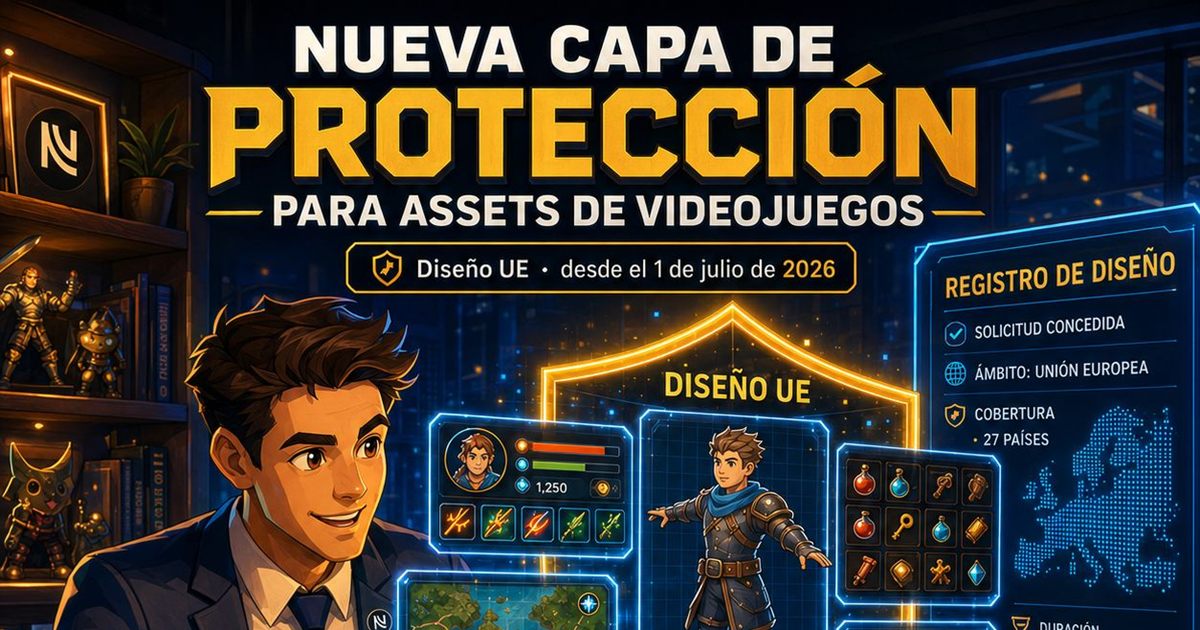
If your studio has been registering characters, illustrations and interfaces with the Spanish Intellectual Property Registry (Registro de la Propiedad Intelectual), you have not wasted your time and you do not need to change systems. What has happened is that since 1 July 2026 you have a second layer available, far more practical for certain visual assets: the registered European Union design filed with the EUIPO. The right strategy is not to replace one with the other. It is to stack them.
Two layers that do different things
The usual confusion is to treat intellectual property registration and the design as alternatives. They are not, because they do not protect the same thing and they do not do the same job in litigation.
The Intellectual Property Registry records copyright. It does not create the right: intellectual property belongs to the author from the very moment the work is created. What registration does is strengthen the evidence, because the registered rights are presumed, unless proven otherwise, to exist and to belong to the holder in the form shown in the entry.
The European Union design does not protect the creative work in its full dimension, but the visible appearance of the product or of a part of it, as represented in the application.
The difference is easier to see if you picture the lawsuit. In copyright proceedings you will have to argue the originality of the element, ownership, the defendant's access to the work and whether there is a legally relevant total or partial reproduction. With a registered EU design, the debate narrows to something far more contained: whether the later design produces a different overall impression on the informed user.
And there is one point that on its own justifies registering: a registered design can be infringed even where the third party developed theirs independently and did not know the earlier one. The unregistered design, by contrast, only allows you to act where there is copying. That is where the real added value for a studio lies.
What exactly has changed
It is not a single law: it is a European legislative package rolled out in two phases.
Regulation (EU) 2024/2822 of 23 October 2024 substantially amended the previous Community designs regime. A good part of its provisions have applied since 1 May 2025, and those which required delegated and implementing acts in order to operate came into play on 1 July 2026. The terminology changed too: what used to be "Community designs" are now European Union designs.
What matters for video games is split between the two dates.
Since May 2025, the substantive definition of a design expressly includes animation, understood as the progressive change of visual features, including movement and transition. It was also clarified that a product may be non-physical and that graphic works, symbols, logos, surface patterns and graphical user interfaces, among others, are included. Computer programs as such remain expressly excluded from the concept of a product protectable as a design.
Since July 2026, the EUIPO has had the complete technical and procedural system for filing those designs in the new formats. In practice you can submit up to ten static representations in JPEG, a dynamic three-dimensional representation in OBJ or STL, or an animated representation in MP4, each with its own technical requirements on resolution, duration and file size.
Two claims in circulation deserve qualifying, because they are not accurate:
- It is not true that "minimum quality is no longer required". What happens is that poor quality or a non-neutral background no longer automatically prevents obtaining a filing date. The representation still has to be sufficiently clear and there are specific technical requirements.
- Nor is there general freedom to correct images after filing. Immaterial details may be amended, during examination or after registration, but you cannot redo the design, add essential features or alter the identity of the protected subject matter. Alteration after registration is also subject to a fee.
What still goes to the Intellectual Property Registry
First and most obvious: the source code, and where appropriate the executable and the program's technical documentation. The designs reform does not protect software as such, only certain visual outputs of that software. The regional rules governing the territorial registries expressly provide for filing the source code and an executable for computer programs.
And alongside the code, all the creative material:
- Scripts, dialogue, lore and narrative documentation.
- Music, compositions and recordings.
- Illustrations and concept art.
- Character, background and environment designs.
- Spritesheets and cinematics.
- Animations, as audiovisual or graphic works, where they are original.
- Art books, visual bibles, manuals and documentation.
- Interfaces and graphic sets.
- Substantially modified versions of all of the above.
Registering separately is particularly advisable where the asset has standalone value, can be exploited outside the video game or was created by a different author. A main character that may end up in merchandising, a series or a sequel deserves its own entry. By contrast, hundreds of secondary icons or minor sprites can be grouped into a properly identified work or collection, unless one of them has particular commercial or litigation value.
There is a further reason, and it is the one that avoids most problems in practice: the real problem for many studios is not proving that the character exists, but proving that the company properly received the rights from the illustrator, the animator, the composer or the freelancer. Where the chain of title is complex, separate registration helps put it in order.
What to add now as an EU design
There is no point taking everything you deposit at the Intellectual Property Registry to the EUIPO. The sensible approach is to select visual assets with commercial value, risk of copying and sufficient useful life.
For an average video game, between five and fifteen well-chosen designs. For example:
- The main character.
- Two or three iconic characters or enemies.
- The main HUD.
- The inventory screen.
- An interface transition in MP4.
- The protagonist's signature animation.
- The main logo or emblem.
- Two or three especially recognisable items, weapons or vehicles.
- The three-dimensional model of the commercially most important element.
The rest remains protected through copyright and the contractual paper trail, which is no small thing.
Characters, interfaces, icons and animations, one by one
Characters
As EU designs I would register those protagonists, main enemies, skins or silhouettes with a recognisable appearance. If the character is three-dimensional, an OBJ or STL representation allows the model to be viewed from different angles. A series of up to ten JPEG views is also possible.
If you want to protect both the static appearance and a signature animation (its attack move, a transformation, a celebration), the prudent course is to file separate designs: one for the static appearance and another for the animated sequence. Technically the EUIPO accepts ten static representations or one dynamic or animated representation per design, not an unlimited combination of formats within the same application.
Interfaces and HUD
An interface can be a product protectable as a design. What is protected is its appearance: composition, shapes, icons, layout, colours and visible transitions. What is not protected is the abstract functionality, the navigation logic, the code that runs it or the idea that a button triggers an action.
The efficient route is to file separate designs for the main screen, the in-game HUD layout, the inventory, the skill tree, the character selection screen, the map and the relevant visual transitions.
Icons, items and inventory elements
Individual JPEG representations where the element is sufficiently distinctive. Here the visual disclaimer is very useful: it allows you to exclude from protection whatever appears in the image merely as context. You can protect a specific icon by showing the full interface while visually excluding the rest of the screen. Disclaimers have to be applied consistently across all views.
Patterns, textures and ornamentation
Especially useful for repetitive elements applied to environments, costumes or interfaces.
Logos and emblems
Combined protection is usually advisable: copyright if they are original, an EU design for their appearance and a trade mark where they perform a function of identifying the company or the video game. The design is no substitute for the trade mark where the element is going to be used as a distinctive sign for years: they are rights with different intended lifespans.
Animations
Only those with a visual identity of their own: a transformation, a summoning sequence, an interface transition, the opening of a loot box, a signature combat sequence or a recurring visual move.
And one mistake worth avoiding: do not file a long gameplay video thinking that the whole game will be protected that way. The representation determines the subject matter and the scope of protection. The more heterogeneous elements appear in the file, the harder it will be to determine what exactly constitutes the registered design.
The procedural shift: register before you show
This is where most studios are going to get it wrong, because it contradicts the habit acquired with copyright.
For copyright, disclosing a work does not remove protection. A character remains protected even if the game launched years ago.
With designs, novelty is critical. The EU design has to be new and have individual character at the filing date. There is a twelve-month grace period for disclosures made by the designer or their successor in title, but it should not become your ordinary way of working.
And disclosing is much easier than it seems. A Steam page, a trailer, a Kickstarter campaign, a public demo, a post on X, Instagram or TikTok, an ArtStation or Behance profile, a trade fair, a press presentation without confidentiality, a development video, an open beta or the marketing of the game itself all count as disclosure.
The correct procedure is therefore inverted:
- Select the protectable assets.
- File the designs with the EUIPO.
- Only then publish the trailer, the store page, the demo or the promotional material.
If the asset has already been disclosed, work out immediately whether the twelve months of grace are still open. Once those twelve months have passed, registering that same asset as a design will generally be risky, because the disclosure itself may have destroyed its novelty or its individual character. That does not affect its copyright or its entry at the Intellectual Property Registry, which remain intact.
For games already published, the alternative is to identify what has not yet been shown: redesigns, new skins, rebuilt interfaces, remasters, new three-dimensional models or unreleased animations.
Registered or unregistered: why it is not the same
The unregistered European Union design can arise automatically upon public disclosure within the Union, but it lasts three years and requires you to prove that the later design was copied.
The registered design lasts five years, renewable in five-year periods up to a maximum of twenty-five, and offers stronger protection, because it also reaches similar independent developments.
In practical terms: with the unregistered design you have to prove you were copied. With the registered one, it is enough that the overall impression matches. In an industry where cross-inspiration is constant and proving copying is extremely difficult, that difference is everything.
How to use the two layers together
For a strategic asset, the complete file should contain:
- The contract or document evidencing who commissioned the creation.
- The assignment of rights from the designer, illustrator, animator or employee.
- Source files: PSD, Blender, Maya, Spine, Aseprite, Figma or others.
- Version history and metadata.
- Entry at the Intellectual Property Registry.
- The EU design application before disclosure.
- Dated evidence of the first disclosure.
- Trade mark registration where the asset also works as a distinctive sign.
That entry at the Intellectual Property Registry proves particularly useful in an uncomfortable but real scenario: a third party trying to register as an EU design a character, icon or interface previously created by your studio. The Regulation allows you to seek a declaration of invalidity of a design that constitutes an unauthorised use of a work protected by copyright. The entry does not decide the proceedings on its own, but it makes it enormously easier to prove the existence of the right, ownership and the content of the earlier work.
Invalidity actions and their new evidential burden
Since 1 July 2026 invalidity proceedings have been more demanding from the outset: whoever seeks a declaration of invalidity must structure from the beginning the facts, evidence and arguments supporting each ground.
In invalidity actions for lack of novelty or individual character, proving the disclosure of the earlier design becomes especially important: which design was disclosed, when, where and how.
This has a direct effect on your evidence policy. The Intellectual Property Registry is very good at proving the existence and ownership of the deposited work, but it does not always prove on its own when it was made available to the public. For an invalidity action based on lack of novelty you will also need evidence of disclosure, and it pays to keep it from day one: authenticated captures of digital storefronts, URLs and dates, original trailers, social media posts, press releases, archived versions of web pages, certificates of participation in trade fairs, distributed builds, publishing agreements and platform launch reports.
A layered audit
All of the above falls into place once you stop thinking about "registering things" and start thinking in layers:
- Copyright layer: code, music, script, characters, illustrations, animations, environments, interfaces and documentation.
- EU designs layer: strategic visual assets, new and commercially recognisable.
- Trade marks layer: the name of the game and of the studio, logos, franchise names and, in certain cases, characters or icons used as identifiers of origin.
- Contractual layer: assignments from employees, freelancers, co-authors, publishers and suppliers.
- Evidence layer: versions, repositories, source files, disclosure dates and traceability.
The conclusion is clear: registering only at the Intellectual Property Registry was not wrong, but it was incomplete from an industrial property perspective. That registration gives you a solid evidential base over the creative elements. The reform now allows you to add a particularly effective registered European right over their appearance, whether static, three-dimensional or animated.
Frequently asked questions
▸Can I register a video game character as a European Union design?NPC
▸Does the EU design replace registration with the Spanish Intellectual Property Registry?NPC
▸Can a video game's interface be protected?NPC
▸Can I register the design after publishing the trailer?NPC
▸What counts as disclosure of a design?NPC
▸How long does EU design protection last?NPC
▸Can the game's code be registered as a design?NPC
▸How many designs should I register for a video game?NPC
Sources
- Regulation (EU) 2024/2822 of 23 October 2024 on European Union designs (EUR-Lex)
- European Union Intellectual Property Office (EUIPO)
- Real Decreto Legislativo 1/1996, the Spanish Intellectual Property Act (BOE)
- Spanish Intellectual Property Registry (Ministry of Culture)
At NN Agency we advise studios and developers on intellectual property and trademark registration and plagiarism and rights infringement litigation. If you are about to announce a game, the conversation about what to register has to happen before the trailer, not after.
Facing something similar at your studio? The first consultation is free.
Free consultation