
Am I the author of content I generate with artificial intelligence?
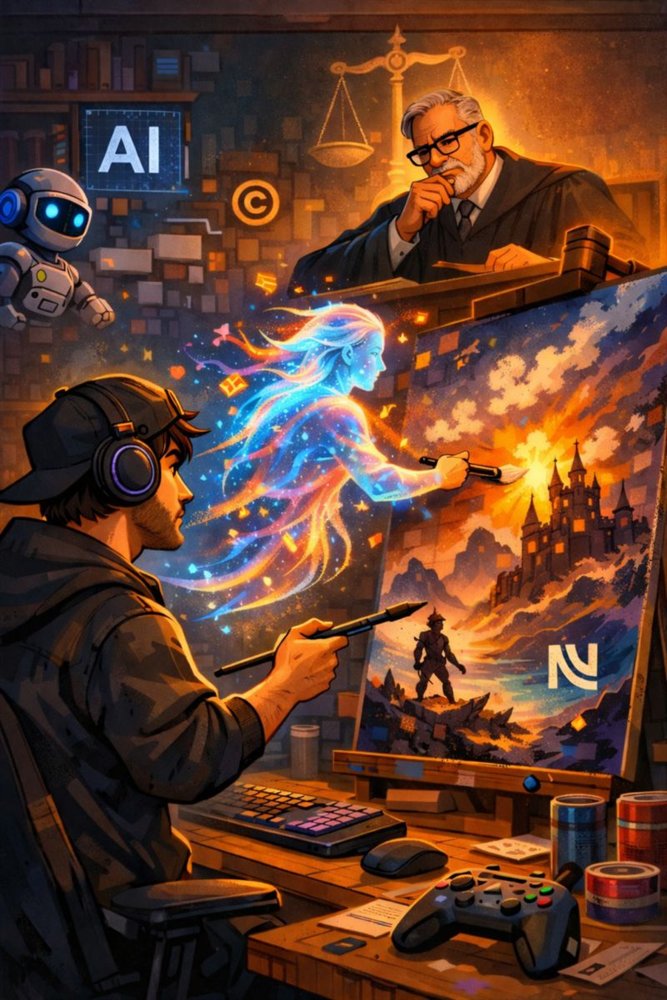
Although the European legal framework keeps trying to adapt to new technologies (regulatory initiatives, application of the classic rules of intellectual property), judicial practice remains fragmentary, and the question of whether an AI-generated result can qualify as the user's own intellectual creation is still up in the air. What is starting to emerge is a set of criteria, and they are quite demanding.
What exactly the law protects
To answer that we must turn to Spanish law, in line with Article 2 of the Berne Convention and with the European standard set by the Court of Justice of the European Union.
The Spanish Intellectual Property Act (Ley de Propiedad Intelectual) protects original literary, artistic or scientific creations expressed in any medium, provided they constitute the author's own intellectual creation and reflect the author's free and creative choices.
It is worth noting that none of those requirements mentions the tool. The law says nothing about brushes, cameras, graphics tablets or generative models. What it demands is that there be a person who decides, and that those decisions be visible in the result.
The requirement that conditions everything: the author is a person
Before any discussion about originality there is a prior filter that gets skipped far too often, and which in Spain is categorical.
Article 5 of the Spanish Intellectual Property Act provides that the author is the natural person who creates the work. In other words: an artificial intelligence system cannot be an author, nor can the company that develops it merely by virtue of having developed it, nor the model that produced the result.
From that follows what really matters. The question is never “does this image have copyright?”. The question is “is there a person whose creative contribution can be recognised in this image?”. If the answer is no, the consequence is not that the result belongs to someone else: it is that there is no protected work, and anyone can use it.
That consequence is the one that usually surprises clients. This is not a discussion about who something belongs to, but about whether that something belongs to anyone at all.
The European standard: free and creative choices
The bar has been set over the years by the Court of Justice of the European Union, and it is the same one applied to a photograph, a database or a text:
- The result must be the author's own intellectual creation.
- The author must have been able to make free and creative choices and must have left their personal stamp on the work.
- And, conversely, the form must not be dictated by technical considerations, by rules or by the very function of the element, because then no room is left for originality.
That case law also made clear that effort and skill are not enough on their own. Working hard is not the same as creating something original. It is an especially relevant point here, because the usual argument of anyone claiming authorship of an AI-generated result is having spent many hours trying out prompts.
The first European ruling, and how to read it
The scant case law that exists reflects a negative perception on the part of the courts, which take the view that the result is largely determined by the AI system itself and that the human contribution lacks the essential character required.
The reference decision is the judgment of the Amtsgericht of Munich of 13 February 2026 (case 142 C 9786/25), concerning three logos generated with an AI tool from the claimant's own instructions and later used by a third party without his consent.
The court refused copyright protection. Its reasoning, based on the German copyright act, is that only personal intellectual creations are protected, and that a creation process purely controlled by software does not in itself amount to a relevant creative contribution. Protection would only be available if, despite the automated process, a person shapes the result through their own individual and creative decisions.
That said, the ruling has to be read with precision, because it is widely miscited:
- It is not a supreme court judgment. The Amtsgericht is the German court of first instance, the lowest tier of the civil court system.
- It is not final. The decision was issued as open to appeal, so it can be overturned.
- It is not binding in Spain. It is German law applied by a German court.
That being so, it should not be underestimated either: it applies the same European originality standard that governs here, and it is the first time a European court has analysed the question in depth. It signals a trend, not settled doctrine. Anyone building their strategy on the assumption that a Spanish court would rule the same way is getting ahead of themselves, and so is anyone who ignores it.
The uncomfortable detail: the detailed prompt was not enough
Here is the nuance that changes practice the most, and the one least talked about.
In the Munich case, the instructions given to the system were not generic: they were elaborate. And even so the court considered they were not enough, because they remained open-ended instructions: they described what was wanted, but the specific configuration of what finally appeared was decided by the system. Nor were the subsequent manual corrections considered sufficient, as a general matter.
The practical reading is uncomfortable but useful: what is examined is not the length of the prompt, but whether you decided the specific result. A thousand-word prompt describing an intention still leaves the execution in the system's hands. Five instructions fixing composition, framing, palette and the position of each element, by contrast, start to look like an author's decisions.
Why the restrictive trend also brings something good
Restrictive as it is, this line of decisions has a positive effect: rulings are starting to shape criteria which in the future could allow copyright to be recognised in certain scenarios.
And they do so by shifting the focus: from examining only the final result to examining the human creative involvement in the generation process. That turns an abstract debate about what art is into something far more manageable for a law firm: a question of evidence.
Which has an immediate and very practical consequence. If the process is what will decide the case, the process has to be kept on record. And that is decided on day one, not the day the dispute appears.
Four indicators of an author's own intellectual creation
With all of the above on the table, these are the main elements which, in our view, can serve as indicators of an author's own intellectual creation by the user.
First, a recognisable personal stamp. It is vitally important to identify beforehand which stylistic, conceptual or visual traits characterise the author's work, and then to show that those traits are easy to recognise in the generated result. It helps a great deal to incorporate assets previously created by the author, recurring visual styles and conceptual elements that make the author's stamp identifiable within the final work.
Second, instructions on specific compositional choices. Courts tend to dismiss overly general prompts, so you have to show that the instructions were specific, detailed and aimed at compositional decisions, not at a description of intentions.
Third, a documented iterative process. A process based on several iterations, adjustments and refinements over time can serve as evidence that the user exercised real creative control over the result, and that it was not something obtained automatically with a single prompt.
Fourth, a visible imprint on the result. The creative decisions introduced by the user must be reflected in an objective and recognisable way in what is generated. It is not enough that they existed: they have to show.
What this means for a video game studio
A studio using generative AI in its production pipeline faces three fronts, and only one of them is the subject of this article.
The first is the one we have just seen: part of your material may not be protected. If a competitor copies a texture, an icon or a background generated without sufficient creative input, you may have no intellectual property claim over that specific element. That does not affect the video game as a whole, which remains protected as a complex work through everything else, but it does affect that isolated asset.
The second is contractual. If you sign with a publisher declaring that you own all the material delivered, that declaration has to be true. It pays to know which part of the material has a debatable ownership before warranting it in writing, not after.
And the third is the chain of rights: what the terms of the model provider say about ownership and commercial use of what it produces. That is a contract, not intellectual property, and it is resolved by reading it.
And a separate obligation not to be confused with it
Two issues that sound similar should not be mixed up.
One thing is whether you are the author of what is generated, which is what this article is about. A different one is the transparency obligation under the EU Artificial Intelligence Act (AI Act), whose Article 50 applies from 2 August 2026 and requires, among other things, that users know when content has been artificially generated or manipulated.
They are independent questions: you may have to disclose that something was generated with AI and, at the same time, not be its author. And vice versa. We develop this in our article on the artificial intelligence act.
Frequently asked questions
▸Can I register a drawing made with artificial intelligence as my own?NPC
▸Does a very long, detailed prompt make me an author?NPC
▸Is there any supreme court judgment on this?NPC
▸If my AI-generated image is not protected, who does it belong to?NPC
▸What should I keep to be able to prove my creative contribution?NPC
▸Does this affect my entire video game?NPC
▸Can I warrant to a publisher that I own all the material?NPC
▸Is being the author the same as having to disclose that I used AI?NPC
Sources
- Real Decreto Legislativo 1/1996, the Spanish Intellectual Property Act (Ley de Propiedad Intelectual) (BOE)
- Berne Convention for the Protection of Literary and Artistic Works (WIPO)
- Judgment of the Amtsgericht of Munich of 13 February 2026, case 142 C 9786/25 (Institut für Urheberrecht und Medienrecht)
- Regulation (EU) 2024/1689 on Artificial Intelligence (EUR-Lex)
At NN Agency we advise studios and creators on intellectual property and trademark registration, publishing, co-development and licensing contracts and plagiarism and rights infringement litigation. If you use generative AI in your production, keeping the process on record is the first measure, and it costs nothing.
Got a similar case in your studio? The first consultation is free.
Free consultation