
Who owns the source code a contributor without a contract adds to your video game? Can they make you remove it?
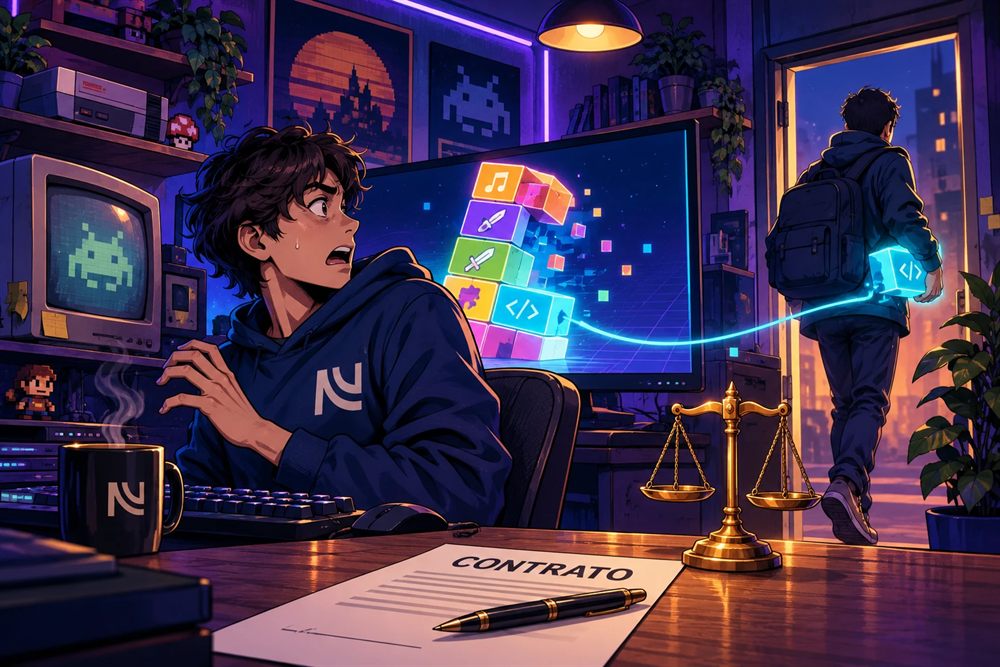
Source code belongs to the person who writes it, unless that person is an employee or has assigned their rights in writing. That is the answer under Spanish law, and it is an uncomfortable one for any studio, because when nothing has been signed whoever leaves can call into question whether the game may keep using their part. It is what is happening to Skyblivion, the volunteer project that has spent years rebuilding Oblivion inside the Skyrim engine. On 30 October 2026 its team said that a former contributor is threatening to sue over the code they wrote for the project. The team says it is confident in its right to keep using that code and, even so, it has removed it and rebuilt the system from scratch.
What happened with Skyblivion
Skyblivion is a non-profit project by the modding group TES Renewal Project, which rebuilds The Elder Scrolls IV: Oblivion in the Skyrim engine. It is made by volunteers and, as Eurogamer reports, Bethesda tolerates it on condition that all of the original game's assets are replaced.
According to the statement the team published on 30 October, as reported by the specialist press, a volunteer left the project and the two sides disagreed over the continued use and maintenance of the code they had contributed. The team lost access to the original repository, and in order to fix issues and keep that system working it decompiled part of the code. The former contributor responded, again according to the team, with legal threats and with a demand for the real names and home addresses of the project leads.
The team says it has consulted legal counsel and is "completely confident in our right to maintain the code they submitted". It nevertheless decided to remove the code and rebuild the whole system to protect its volunteers. Two caveats before going further. We only have the team's version, because the former contributor has not spoken publicly, and there is no confirmation that a lawsuit has actually been filed.
What interests me about the case is how ordinary it is. A project that grows with people coming and going, without a single signed page, and a game system that depends on the code of someone who is no longer there. It can happen to a mod and it can happen to a five-person indie studio.
Copyright in source code arises in the person who writes it
In Spain the code of a video game is protected as a computer program, by copyright, in both its source and its compiled form. What is not protected are the ideas and principles behind it, under Article 96 of the Intellectual Property Act. The mechanic is free, but the specific way someone has programmed it has an owner.
That owner is, to begin with, whoever writes the code. Article 97.1 of the Act treats as author of the program the natural person or group of natural persons who created it. No registration or copyright notice is needed, because the right arises on creation. Registering or depositing the code helps to prove who had it and on what date, but it does not decide who owns it.
From there, the law offers only two routes for the code to end up belonging to the studio. The first is that an employee wrote it. The second is that its author assigned it.
The employee, the freelancer and the volunteer are not in the same position
The employee. This is the only case in which the law does the studio's work for it. When an employee creates a program in the course of their duties or following the employer's instructions, the exploitation rights belong exclusively to the employer, unless otherwise agreed, in both the source code and the object code. That is Article 97.4.
The freelancer. There is no equivalent rule. The external programmer who invoices for an inventory system, for the netcode or for an internal tool remains the owner of what they write until they assign it. And an assignment has two requirements that almost nobody meets when the job is agreed over Discord. It must be made in writing, under Article 45, and it only covers what it expressly says. If the contract does not set a term, the assignment lasts five years. If it does not set a territory, it is valid only for the country where it was signed. If it does not list the forms of exploitation, it is limited to the one that necessarily follows from the contract itself and is indispensable to fulfil its purpose. All of this comes from Article 43, and it is the reason why an invoice that simply says software development does not prove that the code is yours.
The volunteer, the friend and the de facto partner. This is the Skyblivion case, and the case of many studios when they start out. There is no salary and no contract, so there is neither a statutory presumption nor a written assignment. Whoever contributes code on those terms keeps all their rights in it.
What the studio has when nothing was signed
The absence of a document does not mean the studio is using the code without permission. Someone who pushes their work to a project's shared repository so that it is built into the game is authorising that use by their own conduct. The problem is how far that authorisation goes and how long it lasts, because everything that is not written down will be argued over later, and the law pushes the answer towards the bare minimum.
When the dispute breaks out, the studio usually relies on one of two concepts.
- The work of joint authorship. If the game is the unitary result of the work of several authors, the rights belong to all of them in the proportion they agree, as Articles 7 and 97.3 provide. This has one advantage for the project, which is that once the work has been released no co-author may unjustifiably refuse consent to its continued exploitation in the form in which it was released. And it has a high cost, because modifying the work requires the consent of all of them and, failing agreement, a judge decides.
- The collective work. If the game is created on the initiative and under the coordination of a person or company that publishes and releases it under its own name, and the contributions merge into a single creation, the rights belong to whoever publishes and releases it, unless otherwise agreed. That is what Articles 8 and 97.2 establish, and it is the concept that suits a studio best. However, that initiative and coordination must be proved, and it is hard to sustain when the contributor developed on their own a module that can be separated from the rest.
Neither is a substitute for a contract. Both mean going to court to find out which one applies, and that is exactly the scenario to avoid.
Can the contributor force you to remove their code?
It depends on what can be proved, which is why the honest answer is that they can try and the outcome is uncertain.
The owner of an intellectual property right can ask for the infringing activity to stop and for damages, and can apply for urgent interim measures before there is a judgment. These are the remedies in Article 138 of the Act. A contributor who argues that their permission was limited, or that they have withdrawn it, therefore has a route to ask for their code to be taken out of the game. The studio will defend itself with the authorisation inferred from the facts and with the two concepts described above. Whoever has no paper arrives at that argument with emails, chat messages and the repository history as their only evidence.
There is also one right that no contract removes. The author can always demand to be recognised as the author, because that is one of the moral rights in Article 14, which cannot be waived. In practice this means the credits. Removing someone who left on bad terms is the quickest way to hand them an argument.
And there is a cost that arrives even if nobody sues. The first thing a publisher checks before signing, and an investor before coming in, is the chain of title, meaning that every piece of the game has a document behind it saying who owns it. A system written by someone who signed nothing is a gap in that chain, and it turns into a lower price, a personal guarantee from the founders or a signing that is delayed until the paper appears. We explained it when writing about a soundtrack composed by a freelancer, where the problem is identical.
Is decompiling a game legal? The Top System case
Decompiling means reconstructing the source code from the compiled program. Because it involves reproducing and transforming the code, it is an act reserved to the rightholder. The law allows it without their authorisation in two cases.
To correct errors. Article 100.1 of the Spanish Intellectual Property Act allows the lawful user to reproduce and transform the program, including for error correction, where that is necessary to use it for its intended purpose, unless the contract provides otherwise. The Court of Justice of the European Union clarified the scope of this rule in its judgment of 6 October 2021 in Case C-13/20, Top System. A Belgian public body had decompiled part of a program it held under licence in order to disable a function that was failing, and the developer sued. The Court held that the lawful purchaser of a program is entitled to decompile it, in whole or in part, in order to correct errors affecting its operation, without having to meet the requirements laid down for interoperability.
The same judgment sets the limits, and they are the ones that matter in a case like Skyblivion.
- Decompilation must be necessary. It is not when the source code is legally or contractually accessible to the user, as paragraph 63 states. If the team did lose access to the repository, as it says, that is the fact that may make decompilation necessary.
- It is only allowed to the extent necessary for the correction and in compliance with what was agreed with the rightholder. The contract may regulate how errors are corrected, for example by entrusting maintenance to the author, but it cannot exclude every possibility of correcting them, according to paragraphs 66 and 67.
- The result cannot be used for anything else. Neither to develop a similar program nor to distribute the code obtained, in line with paragraphs 69 to 72.
For interoperability. Paragraphs 5 to 7 of Article 100 allow decompilation where it is indispensable for an independently created program to work with others, under strict conditions. Only the necessary parts, only if the information was not readily available, and without using what is obtained to create a substantially similar program.
Both exceptions share a starting point. They protect the lawful user, that is, whoever has the right to use the program. And that takes the discussion back to the beginning, because a studio that cannot prove its permission over the code will not find it easy to prove that it decompiled it lawfully either. The missing paper contaminates this defence too.
What your studio should sign before the first line of code
At NN Agency we recommend that nobody touches the repository without first signing a contributor agreement, even if they are a friend and even if they are not paid. These are the points that cannot be missing.
- A written, exclusive assignment of rights. Exclusivity has to be stated expressly, as Article 48 requires. If it is not, the assignment is non-exclusive and the author can give the same code to someone else.
- Forms of exploitation, term and territory. Reproduction, distribution, communication to the public and transformation, on all platforms, worldwide and for the full duration of the rights. What is not named is not deemed assigned.
- Successive versions and derivative works. Article 100.4 already prevents the author from objecting to the assignee making successive versions of the program, unless otherwise agreed. It is worth writing it down and extending it to sequels, ports and DLC.
- The repository belongs to the studio. Accounts, access rights and backups are controlled by the company, not by the person who set up the server on day one. And code is always delivered as source, documented.
- What happens if they leave. Handover of all material, maintenance during a transition period and confirmation that the assignment stands even if the relationship ends badly.
- Credits. How and where their name will appear, including if they leave the project.
- Third-party code. A statement that what they contribute is original and a list of the open source libraries it includes, with their licences. We covered this in how to release a game that uses open source code.
- Confidentiality. The code and internal tools are also a trade secret, protected as we explained in how to protect a studio's know-how.
If the project is open or community-driven, like a mod, the alternative is to publish the code under an open source licence and require every contributor to accept its terms when contributing. Mods also have their own problem with the owner of the original game, which we covered in who owns a video game mod.
And if there is already code from someone who never signed, the time to put it in order is now, while the relationship is good. An assignment signed today costs a conversation. The same assignment, requested the week before closing with a publisher, has a price. We review the other fronts worth tying down in the legal issues of creating a video game in 2026.
Frequently asked questions
▸Who owns the source code of a video game?NPC
▸Does the company that pays a freelance developer own the code?NPC
▸What should the IP assignment clause in a software development contract say?NPC
▸Can a former contributor demand that their code be removed from the game?NPC
▸Is decompiling a game legal?NPC
▸Are decompilation projects legal?NPC
▸How do you protect the intellectual property in a game's software?NPC
▸Does registering the source code make the studio its owner?NPC
▸What if the contributor was a volunteer and was not paid?NPC
Sources
- Spanish Intellectual Property Act, Articles 5, 7, 8, 14, 43, 45, 48, 96, 97, 100 and 138, BOE, consolidated text
- Judgment of the Court of Justice of 6 October 2021, Top System, Case C-13/20, EUR-Lex
- Directive 2009/24/EC on the legal protection of computer programs, EUR-Lex
- Eurogamer, Skyblivion team says former volunteer is threatening to sue over code dispute, 31 October 2026
At NN Agency, as video game lawyers, we help studios put the ownership of their code, art and music in order, draft contracts with freelancers and contributors before they start working and defend the game when someone claims a part of it. If your project contains code from someone who never signed anything, let's talk before a publisher asks. The first consultation is free.
Facing something similar at your studio? The first consultation is free.
Free consultation