
Can a studio protect the way it works internally?
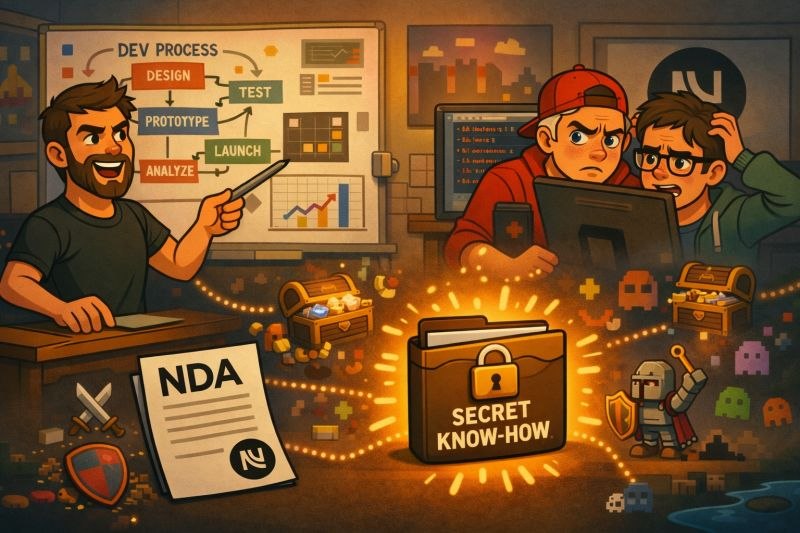
In most game studios the real competitive advantage does not lie in the characters, the art or the code, but in something far less visible: the methodology and internal processes that let a team ship more and better titles with the same resources. That body of practices and knowledge is what we call know-how, and it is almost never protected, because classic intellectual property does not reach that far.
Where the advantage really lies
Two teams can use the same engine and similar technologies and get very different results. The difference is rarely in the tool: it lies in the fact that one has managed to systematise its process and read its data properly, while the other operates in an unstructured way.
That knowledge takes concrete form and is spread across the whole studio: the design guides and their criteria, the metrics that get watched and the thresholds that trigger a reaction, the documentation of in-house tools, the roadmaps, the data dashboards, the way a vertical slice is organised, how work is split between internal and external, or the record of what worked and what did not in each launch.
None of that appears on screen, and it is what a competitor would pay to have.
Why classic intellectual property falls short
This is where the usual intellectual property does not reach. Copyright protects the specific source code, the graphic assets, the music, the dialogue or the narrative design, but not the internal organisational logic that allows you to produce better and faster.
It is not an accidental gap; it is a decision of the system. The Spanish Intellectual Property Act (Ley de Propiedad Intelectual) itself establishes that the ideas and principles underlying any element of a computer program are not protected by copyright. What is protected is the specific expression, not the method.
In plain terms: if a competitor copies your code, you have a claim. If it copies your way of working, copyright is of no use to you. For that layer of strategic information you have to look elsewhere.
The right route: trade secrets
The framework that applies in Spain is the Spanish Trade Secrets Act (Ley 1/2019, de 20 de febrero, de Secretos Empresariales), which transposed the European directive on the matter. It defines a trade secret as any technological, commercial or organisational information that meets three requirements, all three at once:
- It must be secret, in the sense of not being generally known or readily accessible to those who move in that circle.
- It must have business value precisely because it is secret.
- It must have been subject to reasonable measures by its holder to keep it secret.
Note two things. The first is that the Act expressly mentions organisational information, which is exactly what copyright leaves out. The second is that there is no register or filing here: protection is not applied for, it is built.
The requirement almost nobody meets
Of the three requirements, the one that decides real cases is the third, and it is also the only one that depends entirely on you.
If the studio cannot evidence what measures it took to keep that information secret, there is no trade secret to protect. It does not matter how valuable the information was or how obvious it seems that the other side took it: if it sat in a shared folder open to anyone passing through the project, unmarked, with no access control and no associated obligation, the judge is left without the first link in the chain.
And this is what separates a winnable case from one lost before it starts. Reasonable measures do not have to be sophisticated or expensive, but they have to exist and they have to be demonstrable.
What is lawful and worth accepting
It also pays to know where the limit lies, because it protects you from mistaken expectations.
The Act treats as lawful the acquisition of the secret through independent discovery or creation, and through reverse engineering: the observation, study, disassembly or testing of a product that has been accessed lawfully and is not subject to a valid obligation preventing it.
In other words: another studio arriving at a process similar to yours is not, by itself, an infringement. What the law pursues is unlawful acquisition, use or disclosure, not resemblance. That distinction avoids a frequent starting error, which is assuming that any coincidence is misappropriation.
The outsourcing problem
In the day-to-day life of studios this requirement collides head-on with the reality of production. It is common to outsource art, programming, quality assurance, localisation or porting, and that means sharing internal documentation: design guides, metrics, documentation of proprietary tools, roadmaps, data dashboards.
If that flow of information rests solely on a loosely defined NDA, or worse still, on plain email exchanges with no contractual framework, the result is predictable: the knowledge becomes internalised in third parties who later work for competitors with a very detailed understanding of how your studio operates. The competitive advantage erodes and, on top of that, the ability to claim is lost, because sharing without reasonable control is precisely the opposite of taking reasonable measures.
The generic three-paragraph NDA that circulates around the industry does not solve this. It does not define what is secret, does not limit use to the purpose of the engagement, does not say what happens on completion and imposes no return obligation.
When a key person leaves
Another particularly delicate situation arises when a key collaborator leaves the studio, and here a distinction has to be drawn that spares a lot of grief.
Personal experience and skills belong to the professional and cannot be legally ring-fenced. Nobody can stop someone taking with them what they have learnt, or expect them to forget how to do their job.
That said, the use of internal documentation, repositories of in-house tools, user databases or strategic monetisation information can indeed give rise to liability, provided that information was protected as a trade secret. The line runs between what leaves in someone's head and what leaves on a drive.
The tools, one by one
Alongside the NDA, and without replacing it, other legal and organisational tools are worth deploying:
- Specific trade secret clauses in employment contracts and in agreements with external collaborators, identifying which information is considered secret and limiting its use to the purpose of the engagement.
- Clear return and destruction obligations for documentation when the relationship ends, with certification that it has been done.
- Know-how licences, when the aim is not to prohibit but to authorise a specific use on specific terms. A trade secret can be assigned and licensed.
- Internal confidentiality policies: tiered access management, prior definition of what counts as a trade secret, marking of documentation and tools that make it possible to trace who accesses which information and when.
That last part is the one that yields the most and gets done the least. The access log does not just prevent: it is the evidence on which the case is later built.
Watch out for the non-compete clause
The post-contractual non-compete clause always appears on these lists, and a warning is worth adding, because it is very frequently signed badly.
Article 21.2 of the Spanish Workers' Statute (Estatuto de los Trabajadores) only treats it as valid if two requirements are met: that the employer has a genuine industrial or commercial interest in it and that the employee receives adequate financial compensation. In addition, its duration cannot exceed two years for technical staff and six months for everyone else.
If any of those requirements is missing, the clause is void from the outset and produces no effect whatsoever. In other words: a non-compete clause dropped into the contract with nothing paid in return does not protect the studio, it only gives it a false sense of security. And it is exactly what we find in most of the contracts we review.
If it has already happened: what you can do and for how long
The Act provides a range of civil actions against unlawful acquisition, use or disclosure: a declaration of the violation, cessation, a prohibition on manufacturing or marketing the infringing goods, their removal, the surrender of the documentation and compensation for damages, covering both the economic loss and the infringer's unjust enrichment.
And a time limit worth engraving in your memory: actions become time-barred after three years from the moment the person entitled to bring them could do so and knew the identity of the person who committed the violation.
Three years sounds like a long time until it is counted from the day someone walked out and nobody did anything because it was not clear whether it was worth it.
Frequently asked questions
▸Can I protect the way my studio produces video games?NPC
▸Doesn't copyright protect my internal processes?NPC
▸Do I have to register know-how anywhere?NPC
▸What are "reasonable measures" in practice?NPC
▸If a competitor arrives at a process similar to mine, can I claim?NPC
▸Is an NDA enough to work with freelancers and external studios?NPC
▸A key team member has left. What can I do?NPC
▸Is a non-compete clause valid without paying anything in return?NPC
▸How long do I have to claim?NPC
Sources
- Ley 1/2019, de 20 de febrero, de Secretos Empresariales — the Spanish Trade Secrets Act (BOE)
- Real Decreto Legislativo 1/1996, Ley de Propiedad Intelectual — the Spanish Intellectual Property Act (BOE)
- Estatuto de los Trabajadores, Article 21 — the Spanish Workers' Statute (BOE)
- Directive (EU) 2016/943 on the protection of trade secrets (EUR-Lex)
At NN Agency we advise studios and developers on ongoing legal counsel, contracts with collaborators and suppliers and litigation over rights infringement. An access policy is worth more than the best NDA, because it is the one you can later prove.
Facing something similar at your studio? The first consultation is free.
Free consultation