
The perfect commercial strategy for your video game: Atomfall's legal shield
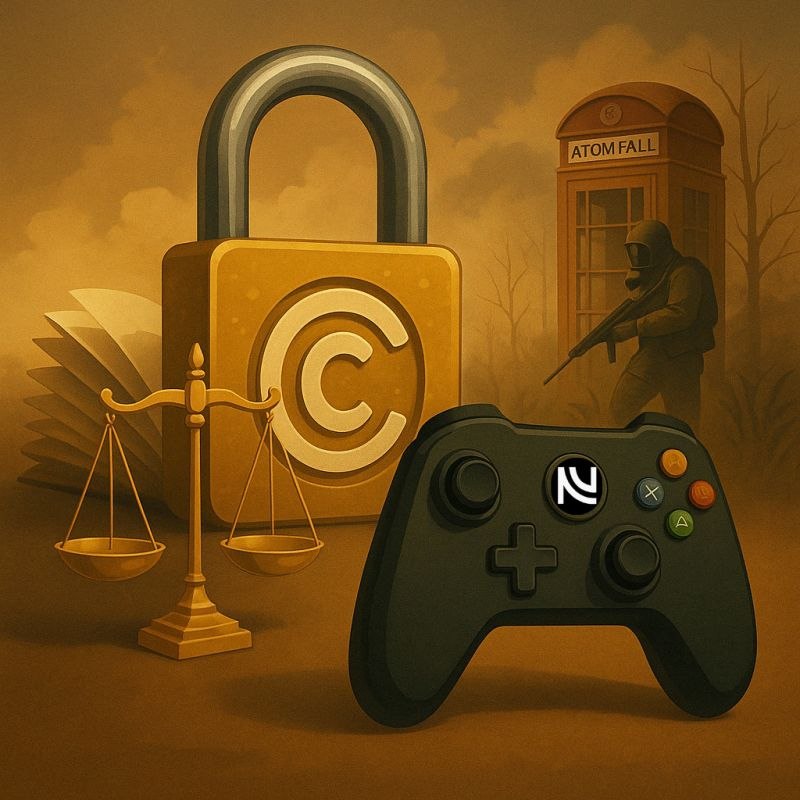
In the video game industry, a good idea is only the starting point. What makes the difference is how that idea is protected and exploited beyond the screen. Legal management of intellectual property is the silent engine that turns a title into a franchise able to grow, diversify and last: from licensing and adaptations to merchandising, a well-shielded IP multiplies its possibilities and its value. And few recent stories illustrate it better than Atomfall.
Why Atomfall is the perfect example
Atomfall, Rebellion's survival game set in a rural, post-apocalyptic England, did not just reach 1.5 million players in its first week and pass 2 million shortly after. It did so with Microsoft's backing, entering Xbox Game Pass from day one, and with a figure its own chief executive made public: the launch was immediately profitable, the most successful in the studio's more than thirty years of history.
That last figure is the one that interests us as lawyers. A day-one deal with a platform like Game Pass is not improvised: it requires the studio to be able to contractually warrant that everything it delivers is its own, that nobody will show up claiming rights mid-campaign, and that future content will be as clean as the initial release. Put differently, Atomfall's commercial strategy rests on a legal structure that was built long before the trailer.
And there is context that explains it: Rebellion is not just a studio. It is a group that owns its own game engine and that has also been, for more than two decades, the owner of comics publisher 2000 AD, the home of Judge Dredd. It is a company that has spent years buying, managing and exploiting intellectual property, and that culture shows in how this game was launched.
First leg: title and the chain of rights
Everything starts with securing title to the work. A video game is the result of the work of programmers, designers, writers, musicians and many other profiles who hold rights over their contribution. Without clear contracts and well-documented assignments, commercial exploitation can be left hanging.
In Spain the default rule helps, but does not solve it alone: exploitation rights over what a salaried employee creates in the course of their duties are presumed assigned to the employer, and for software the law says so expressly. That presumption, however, does not cover freelancers or external studios, who today handle an enormous share of any production: art, music, voice acting, porting, quality assurance. With them, the assignment must be agreed in writing, with its scope, territory and duration, or the gap stays open.
Rebellion had this clear from the start: chain of rights closed and documentation organised, from the game engine (which is also its own) to the music and the art, including trade mark registration. So when the time came to negotiate, it could offer absolute warranties over the title to its video game, covering licensing, merchandising and future adaptations.
What a publisher asks before signing
It is worth spelling out what "absolute warranties" means, because it is exactly what a publisher, a platform or an investor will ask for in the pre-contract review:
- Who made each thing, and under what contract? Staff, freelancers, external studios, licensed music, assets bought in marketplaces.
- Where are the signed assignments from every external collaborator?
- Which third-party components does the game include (engine, libraries, middleware) and under which licence? It is the same review we discussed regarding open source code.
- Is the trade mark registered in the classes and territories where the game will be exploited?
In contracts, all of that condenses into the representations and warranties clauses: the studio affirms it owns everything it delivers and undertakes to indemnify if that is not true. Whoever has the documentation in order signs with peace of mind. Whoever does not, signs anyway, but is taking on a risk they have not measured.
Second leg: anticipating infringement risk
Protecting an IP is not only a matter of paperwork: it also means anticipating risk. And here is a nuance that surprises many studios: the danger does not end with literal copying. Reproducing the style, atmosphere or tone of someone else's work can be enough to enter compromised territory, somewhere between copyright, unfair imitation and, depending on the case, trade marks and design rights.
That is why serious legal work at this stage is proactive, not reactive: studying the market, identifying grey areas and steering creative decisions within safe margins while the game is still being designed. Documenting your own references and the creative process also leaves the defence ready if someone ever claims: being able to show where each choice came from is worth more than any argument made after the fact.
The concrete case: resembling Fallout without stepping on it
In Atomfall's case it was predictable that a post-apocalyptic game would be compared with established titles such as Fallout. And so it happened, from the very first trailer.
But Rebellion anticipated it and was especially careful to stake out its own references: British science fiction of the sixties, the real Windscale nuclear incident of 1957, the English countryside with its red phone boxes and its pubs. An imagery of its own, recognisable and distinct from the traditional models of the genre, which reduced the risk of conflict and, along the way, gave the game a commercial identity no competitor could claim.
The lesson is a fine one: comparison with the genre leader is inevitable and even commercially desirable. What is managed legally is that the inspiration stays within the genre (which belongs to nobody) and not within someone else's concrete expression (which does).
Third leg: traceability of new content
All of the above must also accompany the game's evolution. When an IP grows with sequels, expansions or downloadable content, it is vital that every new element is as well protected as the original: the same contracts, the same assignments, the same registrations.
Atomfall is, again, a good example: its expansion arrived a few months after launch, and that pace is only sustainable if there are clear protocols to register and document each addition without slowing production. Who signs what when a new collaborator joins, how each asset is documented, what gets registered and when.
It is the same point we made about the European Union design: copyright survives disclosure, but other protections are played out on the calendar. The protocol exists so that protection does not depend on someone remembering.
What a small studio can copy from this
None of the above requires Rebellion's size or budget. The independent-studio version fits in four measures:
- A title file per project: contract and assignment for every person who touches the game, including one-off commissions, and the inventory of third-party components with their licences. It opens on day one and is fed as you go.
- The trade mark registered before the announcement, in the classes that actually matter. It is the cheapest piece of the whole system and the most often forgotten.
- A reference map for the project: which works inspired what, and which decisions were taken to differentiate. Half a page that can be worth a lawsuit.
- A new-content protocol, even a one-pager: what gets signed, what gets documented and what gets registered every time new material comes in.
The difference between doing it now and doing it when the publisher arrives is not one of quality, it is one of price: before, it costs hours; after, it costs renegotiations, indemnities and discounts on the price of your own game.
Frequently asked questions
▸What is a video game's chain of title?NPC
▸If my employees create the game, does my studio already own the rights?NPC
▸Is copying another game's style or atmosphere illegal?NPC
▸What does a publisher look at before signing with a studio?NPC
▸Are DLC and expansions automatically protected?NPC
▸When should all this start?NPC
Sources
- Spanish Intellectual Property Act, Royal Legislative Decree 1/1996 (BOE)
- Spanish Trade Marks Act, Law 17/2001 (BOE)
- Spanish Unfair Competition Act, Law 3/1991 (BOE)
- Rebellion's CEO on Atomfall's launch (VGC)
At NN Agency we help studios and developers close their chain of title and register their trade mark, negotiate with publishers and platforms and prepare the documentation that backs those warranties. The title file opens on the project's first day, not the day the offer arrives.
Facing something similar at your studio? The first consultation is free.
Free consultation