
Google Playground: who owns the game you create with AI?
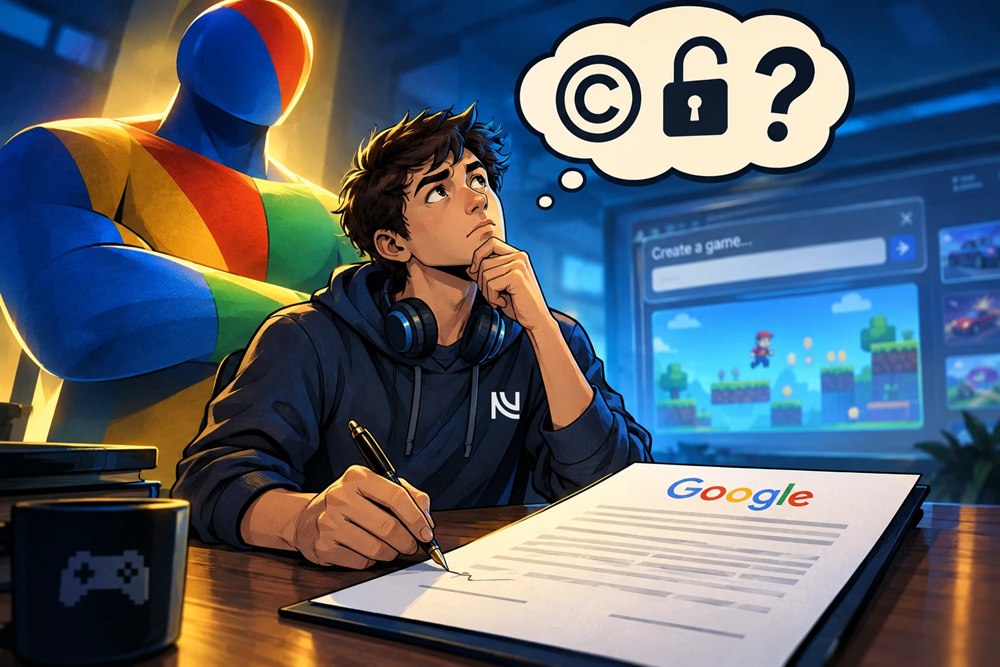
Google has just launched Playground, its AI game maker that creates video games from a simple text prompt: you describe the game, the AI builds it and within minutes you share it with a link. The technology is spectacular and the promise intoxicating: "if you can think it, you can play it". From this firm, though, it falls to us to ask the question the presentation does not answer: when you create a game on Google Playground, who owns it? The answer is not in the announcement: it is in the terms and conditions you accept on the way in. We have read them, and you should know what they say (and what they cannot say).
What Google Playground is (and why it is genuinely good)
Fairness first: Playground is a remarkable leap. Launched as a Google Labs experiment on 7 October 2026, it lets you create games from scratch by describing what you want: you pick a genre template (trivia, tower defence, racing) or a blank project, in 2D or 3D, and editing is conversational: ask for different physics, new rules or another look, and the game changes. Everything runs in the browser (mobile included), is shared with a link or published to the Explore gallery, and underneath run the Gemini, Nano Banana and Lyria models.
Initial access is limited: United States only, adults only, with creation metered through weekly tokens (larger for Google One subscribers). And Google has already announced the next step: a connection to Unity Spark, a professional 3D tool built with Unity, for whoever wants to go beyond the experiment.
In other words: this is not an isolated toy, it is the entrance to a chain that ends in professional development. All the more reason to read the small print from day one.
The mirage: creating anything is not keeping everything
The commercial message of these platforms is always the same: create whatever you want, it is yours, share it. And the reasonable creator concludes: "I made it, therefore I own it".
The law works differently. What you can do with that game is governed by the terms and conditions you accept when using the service, an adhesion contract you do not negotiate and almost nobody reads. And above that contract sit the rules of intellectual property, which neither Google nor you can change however hard the accept button is pressed. Two distinct layers, best walked in order.
What you actually sign: the terms, read
We have read Playground's terms (last modified 20 September 2026). This is what they say, with their literal wording:
- The star sentence: "Google will not claim ownership over Your Games". It is the right clause and better than many platforms'. First layer: approved.
- The immediate flip side: "Google retains all rights in features, services, and assets provided by Google". Everything Google contributes (its tools, services and assets) remains Google's even when sitting inside "your" game. Your game is yours; its bricks are not.
- The monetisation licence: you grant Playground "the right to monetize Your Games", including showing ads in or over them, though with a redeeming nuance: they will ask your permission before doing so.
- The responsibility is yours: "You are legally responsible for Your Games". If your game infringes someone's rights, the problem is yours, not Google's.
- The two key prohibitions: you may not use the services to generate or incorporate third-party intellectual property in prompts without written permission, and you may not remove, obscure or alter the watermarks and labels flagging content as AI-generated.
- Exits: you can unlist your games (visible only to you and whoever holds the link) or delete them from the service entirely, whenever you want.
And a lawyer's detail: for the full scope of the licence you grant Google (hosting, reproduction, communication, modification), Playground's terms refer back to Google's general Terms of Service and their "permission to use your content" section, a worldwide, royalty-free licence rather broader than the game page suggests. The full picture takes reading both documents, not one.
The layer the terms cannot give you: copyright
Here comes the part no announcement mentions. Google "not claiming ownership" of your game does not mean your game has an owner.
As we analysed in depth in our article on the authorship of AI-generated content, in Spain (and in Europe) only a natural person can be an author, and there is only a protected work where the result reflects human creative decisions. A game generated entirely by the AI from a generic prompt may fall short of that bar: and then it is not Google's or yours, it may be nobody's, free for anyone to copy.
The practical consequence is serious for anyone dreaming of commercialising the result: your position does not depend on how generous Google's term is, but on how much of your human creation the result contains (the worked level design, the script, the original art you upload, the documented creative iteration). The terms distribute whatever exists; the law decides whether anything exists to distribute.
The layer they cannot take away: your hidden rights
And now the good side, the one almost nobody tells you: you may hold more rights than you think, through two routes.
First: everything original you contribute (your texts, your music, your uploaded art, your story, your elaborate design) is yours by law from the moment you create it, not by the platform's concession. Playground's terms may ask you for licences over it, but ownership is born in you, and whatever is not expressly granted stays with you: the same restrictive-interpretation rule we saw with the freelance composer's soundtrack.
Second: these terms are standard conditions drafted by one party alone, and the law has an old, healthy rule for that: obscurity is construed against the drafter, and against consumers abusive clauses are simply void. An ambiguous term about what you take with you, how long a licence lasts or what Google may do with your creation is not read in Google's favour: it is read in yours. In a contract you never negotiated, bad drafting is your ally.
The creator's three practical risks
- The prompt with someone else's IP. The whole community's number one temptation will be "make me a racing game with a plumber in a red cap". The terms prohibit it and make you responsible: generating or incorporating third-party characters, brands or universes without permission is infringement, exactly the kind we analysed regarding trade marks inside a video game. The AI will happily generate it; the legal problem will be yours.
- Your game lives in someone else's house. Like mods built on another's game, your creation depends on the platform: its tokens, its rules, its gallery, its continuity (and Playground is, remember, an experiment). You can delete your games at any time; also plan what you would do if the experiment closes.
- The AI labels are not to be touched. The watermark-removal ban is no whim: it connects with the European transparency obligations over synthetic content we reviewed in the 2026 legal Top 5. Stripping the label off your game does not make it more yours: it makes you non-compliant twice over.
Checklist before creating (and before showing off)
- Read the two pages that matter: Playground's terms and the "your content" section of Google's general Terms. Twenty minutes worth your game.
- Clean prompts: no third-party characters, brands or universes. If your game aspires to anything, let it not be born infringing.
- Put human creation on top: your own design, your own texts, your own uploaded art. The more documentable input of yours, the more protectable a game you have (and the easier it is to prove).
- Keep your creative trail: prompts, iterations, versions. It is the proof of your contribution if you ever have to defend it.
- If the game takes off, get advice before signing anything else: the jump from experiment to product (or to Unity Spark) is the exact moment the small print starts costing money.
Frequently asked questions
▸Who owns a game created on Google Playground?NPC
▸What do the Google Playground terms and conditions say?NPC
▸Can Google put ads in my game?NPC
▸Can I make a game with famous characters on Google Playground?NPC
▸Who owns the copyright in an AI-generated game?NPC
▸Is Google Playground free, and where is it available?NPC
▸Can I sell or commercialise my Playground game?NPC
▸What happens to my games if Playground shuts down?NPC
Sources
- Google Playground Terms of Service (version of 20 September 2026)
- Google Terms of Service, "Permission to use your content"
- Spanish Intellectual Property Act, Royal Legislative Decree 1/1996, articles 1, 5 and 43 (BOE)
- Spanish Civil Code, article 1288 (BOE)
- Google Labs launches Playground (launch coverage)
At NN Agency we help creators and studios understand what they sign on each platform, protect and document their creative contribution and make the commercial leap without losing their rights along the way. If you have created something that is starting to matter, read us before accepting the next button: the first consultation is free.
Facing something similar at your studio? The first consultation is free.
Free consultation