
What is a mod, and what exploitation rights does its creator have?
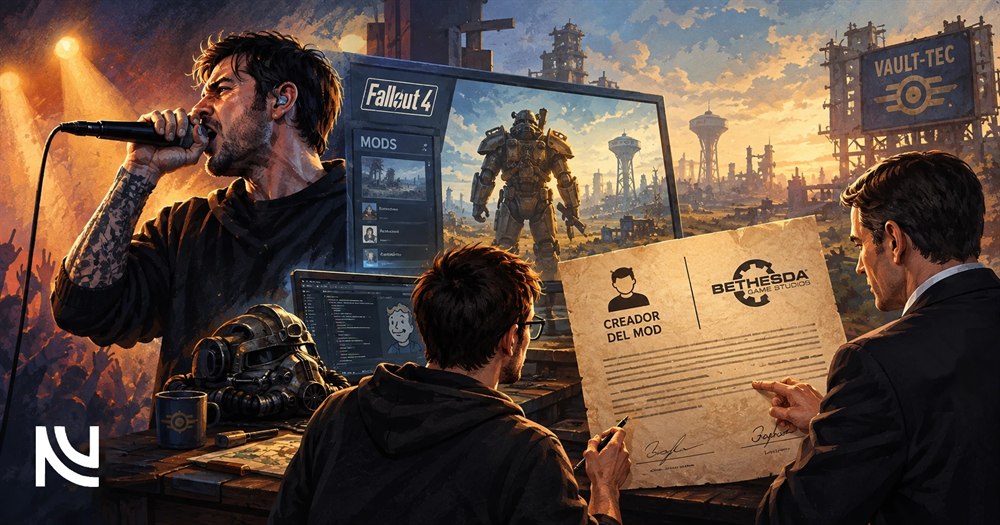
When a studio brings us its video game, we almost always talk about what they create: the code, the art, the characters, the music. But we rarely talk about what the community is going to create on top of their game: the mods. It has taken a rock singer stopping a concert to promote his own, in front of thousands of people, for half the industry to ask itself the question we have been putting on the table at this firm for a while: that content players create for free on top of your game, who does it belong to?
The case: a stage, a microphone and a mod
On 6 September 2026, at a concert in Holmdel (New Jersey), Benjamin Burnley used a technical pause for something unheard of: he spent more than four minutes asking the audience to download his mod for Fallout 4, the game by Bethesda, one of the biggest studios in the world and home to one of the most active modding communities.
He explained the context himself from the stage: another modder had harshly criticised the quality of his work (a mod that turns the game's camera into a full first-person view, with the character's body visible). Burnley answered with the only weapon at hand: downloads. He gave his Nexus Mods username to an entire amphitheatre, the video went viral and the mod jumped from a handful of views to tens of thousands within days.
The anecdote is charming. The question it leaves on the table, less so: that mod a celebrity promotes from a stage, suddenly worth attention, traffic and reputation, who owns it?
What a mod is and why it matters so much
A mod is a modification a player makes to an already published game, to add content or change how it looks or plays. The people who make them are called modders: hobbyists who create them for free, in their spare time, and share them on sites like Nexus Mods.
The phenomenon should not be underestimated, because part of the industry's history is written in mods. Counter-Strike was born as a Half-Life mod; Dota, as a Warcraft III mod; PUBG descends from ARMA's survival mods. Entire genres and billion-dollar franchises started as a hobbyist's weekend project on top of someone else's game. And at the other end, games like Skyrim or Fallout 4 itself remain alive (and selling) more than a decade on thanks, in good part, to their modding communities.
In other words: mods extend the game's commercial life, cement the community's loyalty and sometimes carry the seed of the industry's next hit. All of it created by people who have no contract with the studio. If that does not call for legal analysis, nothing does.
The legal nature: a work built on another work
From the standpoint of Spanish law, a mod fits a figure we know well on this blog: it is a derivative work, a creation built on a pre-existing work, as we discussed regarding board games born from video games. The modder's original contribution (their code, art, textures, design) is protectable and has an author; but the work it is built upon remains the studio's.
And here is the key piece: the transformation of a work is an exclusive right of its owner (articles 17 and 21 of the Spanish Intellectual Property Act). Modifying someone else's game requires, by definition, their authorisation. A mod is not legally possible because the player wants it: it is possible because the studio allows it, and the terms of that permission live in the conditions accepted when installing the game or its creation tools.
That is the frame for the three rules that follow, which in Bethesda's case are written in black and white and which, with variations, repeat across most of the industry.
First rule: the mod belongs to the modder
Whoever creates the mod is its author. Spanish law recognises it (authorship springs from original creation, and the modder's contribution is one) and Bethesda's own terms recognise it expressly: the modder keeps ownership of their original content.
This has real consequences: the modder can demand recognition as the author of their mod, oppose anyone appropriating it, and show it off wherever they like (a concert included). Their work does not belong to the studio, and the studio cannot have a third party sign as their own what the modder made. So far, the part that sounds good.
Second rule: being the author does not mean you can sell it
Now the other face: the mod is a work built on another work. The game remains the studio's, and the mod's protection arises without prejudice to the rights over the pre-existing work. The modder cannot do whatever they want with their mod, because their work does not function (legally or technically) without the studio's.
The most visible manifestation: they cannot sell it or charge for it. Bethesda's modding terms, like those of most large studios, require mods to be distributed for free. Charging for a mod without express authorisation would mean commercially exploiting a transformation of someone else's work outside the permission granted: infringement, no matter how original the added code. Nor is this an exotic hypothesis: every time the industry has attempted "paid mods" without designing them properly (the 2015 Steam experiment lasted four days), the badly resolved mix of rights has blown up.
Third rule: the studio reserves the right to use it
And the third rule, the one almost no modder has read: by accepting the terms, the modder authorises the studio to use, copy and modify their mod, perpetually, for any purpose and without paying them anything. It is an extremely broad licence the studio reserves over everything the community builds on top of its game.
Add it up: the modder owns something they cannot sell and that the studio can exploit for free. It is neither good nor bad; it is what gets signed without reading. The same licence logic we analysed when explaining what you really buy when you buy a game, now applied to the one who creates instead of the one who plays: inside someone else's game ecosystem, your rights are whatever the paper says they are.
What if the game says nothing about mods?
There remains the scenario we meet most often in small studios: the game has no modding terms. It neither allows nor forbids them; simply, nobody thought about it.
Legally, silence is not permission: transformation remains the studio's exclusive right, and an unauthorised mod is, strictly speaking, an infringement the owner could pursue. In practice, the industry lives on generalised tolerance (mods benefit the game, and suing your own community is commercial suicide), but tolerance is not a legal regime: it is a factual situation the studio can revoke, and it answers none of the important questions. May the modder accept donations? May the studio incorporate the mod into the game? Who answers if the mod includes third-party material? Without a written policy, each of those questions is a conflict in waiting, set to explode precisely when the mod becomes famous.
For studios: the mod policy you need to write
That is why any studio publishing on PC should have this decided from the start, and in writing. Our short list:
- What is allowed and what is not: tools, moddable content, red lines (multiplayer cheats, content harmful to the brand, third-party material).
- Which rights the studio reserves over what the community creates: the licence to use it (with its real scope), the right to incorporate mods into the game and on what terms.
- The money, settled in advance: free distribution, donations allowed or not, and if a paid-mods programme ever arrives, how it would be shared.
- The credit: how the modder's authorship is acknowledged if the studio uses their work. It is cheap, it is fair and it prevents half the conflicts.
- The chain of responsibility: the modder's declaration that their content is their own, and a channel to take down infringing mods. Your game should not answer for what a third party put into a mod.
The mod policy is, at bottom, one more piece of the video game's legal shield: the piece governing the only part of your work that will be written by people you never hired. In Spain almost no studio has one, and once a mod goes viral (or a singer promotes it in front of thousands), it is too late to think it through.
Frequently asked questions
▸Who legally owns a mod?NPC
▸Can a modder sell their mod?NPC
▸Can the studio use my mod without paying me?NPC
▸Is making a mod legal if the game says nothing about mods?NPC
▸What if my mod includes other people's content (music, brands, art)?NPC
▸I run a small studio. Do I really need a mod policy?NPC
▸What can modders learn from the Breaking Benjamin case?NPC
Sources
- Spanish Intellectual Property Act, Royal Legislative Decree 1/1996, articles 11, 17 and 21 (BOE)
- Bethesda.net Terms of Service (mods section)
- PC Gamer: Breaking Benjamin frontman pauses concert to rant about Fallout 4 modding beef
- Dexerto: Breaking Benjamin singer pauses concert to get fans to download his Fallout 4 mod
At NN Agency we help studios draft their mod policy and their game's terms, protect their intellectual property against unauthorised uses and resolve disputes over community content. If your game is heading to PC, decide what your players may do with it before they decide for you: the first consultation is free.
Facing something similar at your studio? The first consultation is free.
Free consultation