
Can I integrate any trade mark into the code of my video game?
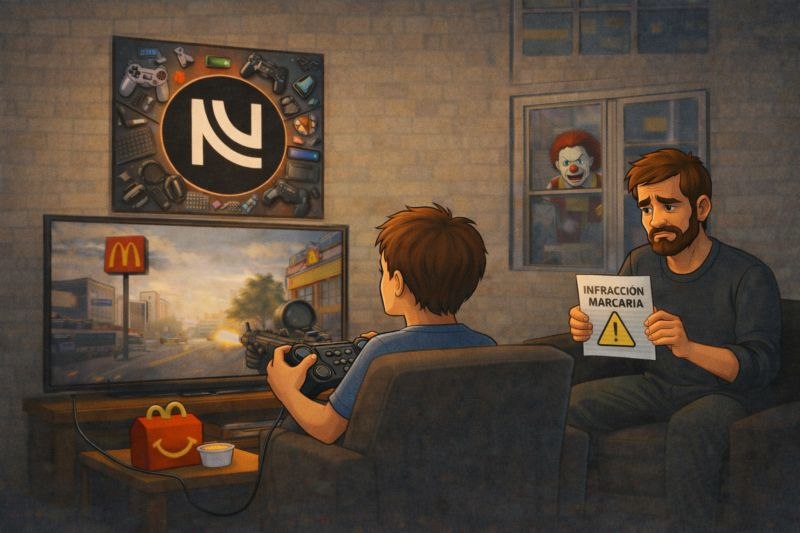
The Spanish Supreme Court's recent ruling on the use of the sign “FUT DRAFT” as a mode built into a video game puts front and centre a question the industry cannot afford to overlook: everything that goes into the code and appears on screen is legally relevant. And the sign does not need to be the game's title for there to be an infringement.
What the Supreme Court has decided
Supreme Court judgment 180/2026, of the Civil Chamber, of 10 February 2026 (appeal 721/2022) resolves the dispute between the owners of the word mark “FUTBOL DRAFT” and Electronic Arts, which used the sign “FUT DRAFT” to identify a specific mode within one of its video games.
The claimants brought the full package of actions: a declaration of infringement, cessation, removal or withdrawal from the market, and damages.
The Supreme Court confirms the trade mark infringement and, most relevantly here, upholds the application of the 1% of turnover under Article 43.5 of the Trade Marks Act, even where the precise quantification of the harm presents evidentiary difficulties. The reasoning is that the lack of exhaustive proof of the volume of business cannot leave the owner without compensation, so a generic award may be made, leaving the calculation for a later stage.
Why code is not neutral ground
Beyond the case decided, the conclusion for developers, publishers and studios is unequivocal: software is not a legally neutral space, and the fact that a sign is implemented in the code does not make it a merely technical element.
For there to be a use in the course of trade capable of infringing a registered trade mark, the sign does not need to be the video game's main title. It is enough for it to perform a distinctive function within the product: identifying, for example, a game mode, a feature, an event or a monetisation system.
That is the point that tends to catch people out. The trade mark conversation in a studio usually centres on the game's name and the studio's logo, the two elements that get registered. But the product's internal naming also identifies, and the moment it identifies, it enters the territory of trade mark law.
Where signs appear in a video game
In practice, video games do not carry signs only on the packaging or in the advertising campaign. They also appear in:
- Game modes and internal names.
- Interfaces and menus, including the names of tabs and sections.
- Time-limited events, seasons and their names.
- Reward systems, packs and stores.
- Scenery, kits, signage and simulated environments, which is where third-party logos end up slipping in when the aim is realism.
That last group deserves attention of its own. A studio recreating a real city, a circuit, a stadium or a shopping centre will usually add signs, awnings and logos to make the environment believable. And that fidelity, artistically a success, is legally a decision that has to be taken deliberately.
The 1% under Article 43.5, properly understood
Three points that are frequently misquoted are worth pinning down here.
First: it is a minimum, not a ceiling. Article 43.5 of the Trade Marks Act grants the owner, in every case and without any need for proof, the right to receive that 1%. If the owner manages to establish greater harm under any of the criteria in Article 43 itself (lost profits, the infringer's profits or the hypothetical royalty), they recover that higher amount. The 1% is the floor below which they cannot be left.
Second: the basis of calculation is not the entire revenue. The percentage is applied to the turnover made by the infringer with the unlawfully marked products or services, not to the company's overall revenue. In a large company, the difference runs to several orders of magnitude, and it is precisely where the expert-evidence battle is fought.
And third: it does not have to be quantified from the outset. That is the practical contribution of this judgment. Evidentiary difficulty does not block the award: the court can find against the infringer and leave the exact determination for enforcement or for later proceedings.
For a small studio the 1% may look manageable. Best not to stop there, because the damages are rarely the most expensive part of the affair.
What really hurts: cessation and withdrawal
Once infringement is declared, the trade mark owner is entitled to ask for rather more than money, and those are the measures that truly put a product at risk:
- In physical format: seeking the withdrawal of copies from the market and halting new print runs or distributions.
- In the digital environment: removing the listing from the platforms, forcing the immediate implementation of a corrective patch, or temporarily suspending sales until the infringing element is completely removed.
Translated into a studio's reality: a game out of the store for weeks, an emergency build that has to go through each platform's certification, and all the promotional material, trailers and support documentation that mention that name, to be redone.
In a game as a service, moreover, renaming an established mode carries a cost that is not only technical: it is a community cost.
The second front: consumers
There is a knock-on consequence that is almost never anticipated. If removing the infringing content affects access to the digital product already purchased, a different exposure opens up: claims from the players themselves under consumer law, with refunds and compensation.
It is exactly the same ground we covered when discussing what you buy when you buy a video game online: what the consumer understood they were acquiring versus what they legally acquired.
Put another way: a trade mark problem can end up turning into a consumer problem, and they are two fronts with different rules, deadlines and counterparties.
When using someone else's trade mark can be legitimate
The existence of risk does not mean every mention is forbidden. The Trade Marks Act provides for limits on the owner's rights, and there are uses that do not amount to infringement: use of one's own name, descriptive indications and, highly relevant here, use necessary to indicate the intended purpose of a product or service, provided it is made in accordance with honest practices.
The criterion that frames all of this is whether the use affects or is liable to affect the functions of the trade mark, and in particular its essential function of indicating commercial origin. It is one thing for a sign to appear in the background of an urban environment, with nobody understanding that its owner sponsors or endorses the game. It is quite another to name a game mode, an event or a pack after that sign, because there the sign is identifying something inside your product.
The line is not always sharp, and precisely for that reason it should be drawn with judgement and in writing before building on it, rather than discovered when the cease-and-desist letter arrives.
What to check before the build
Embedding a sign in the code demands the same level of diligence as registering the video game's own trade mark. Before an asset goes into production and is integrated into the final build, it is essential to verify the existence of earlier rights. That means:
- Reviewing the national registers.
- Reviewing the European registers.
- Assessing potential conflicts due to identity or similarity of the signs and closeness of the products or services.
Only after that availability analysis can the definitive incorporation of the sign into the video game be considered legally safe.
To that I would add four points of method that prevent most of the scares:
- Draw up the list of the product's names, not just the game's: modes, events, currencies, packs, seasons, ranks and subscriptions. There are usually rather more than anyone remembers.
- Search in the classes that actually matter, which in a video game is not just the software class: the entertainment-services classes need checking too and, depending on the case, the merchandising ones.
- Do it early. The later it is caught, the more it costs: changing a name in the design document costs nothing; changing it with the game published costs a build, a certification and a community crisis.
- Leave it documented. If a dispute ever comes, being able to show that the search was done and what was concluded is relevant when assessing conduct.
Frequently asked questions
▸Can I use a registered trade mark inside my video game?NPC
▸What has the Supreme Court said in the FUT DRAFT case?NPC
▸Is the 1% calculated on the company's entire revenue?NPC
▸What can I be ordered to do if I lose?NPC
▸Can I put real logos in the scenery for realism?NPC
▸If I have to remove the content, can players bring claims against me?NPC
▸What do I need to check before putting a name into the build?NPC
▸When is the best time to run that check?NPC
Sources
- Ley 17/2001, de 7 de diciembre, de Marcas — the Spanish Trade Marks Act (BOE)
- CENDOJ case-law search engine (General Council of the Judiciary)
- Spanish Patent and Trade Mark Office (OEPM)
- European Union Intellectual Property Office (EUIPO)
- Texto refundido de la Ley General para la Defensa de los Consumidores y Usuarios — the consolidated Spanish Consumer Protection Act (BOE)
At NN Agency we advise studios and publishers on intellectual property and trade mark registration, plagiarism and rights-infringement litigation and ongoing legal counsel. The product's list of names gets reviewed in the design document, not in the build.
Facing something similar at your studio? The first consultation is free.
Free consultation