
Video game databases: what they are and when they can be protected
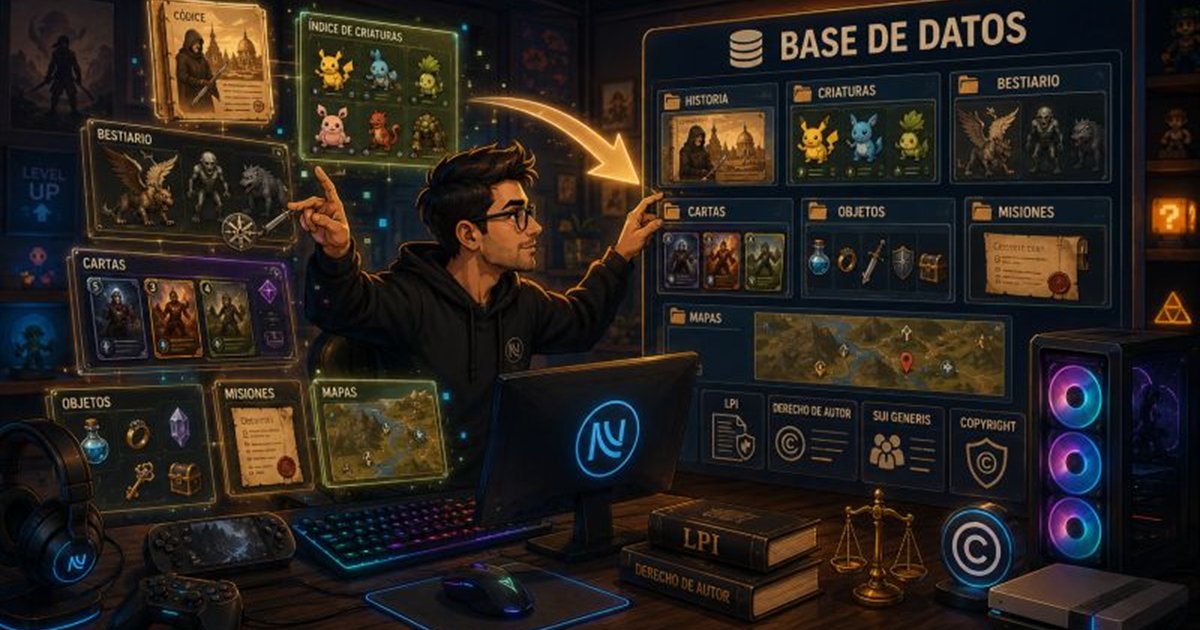
When we think about video game intellectual property, the same things always come to mind: characters, music or software. But there is a less visible asset, often just as valuable, that can also enjoy legal protection of its own: the game's internal databases. And their legal regime has a trap that almost nobody sees coming.
What a database is for legal purposes
Under the Spanish Intellectual Property Act (Ley de Propiedad Intelectual), a database is a collection of independent works, data or other materials, arranged in a systematic or methodical way and individually accessible.
That definition, brought into video game territory, implies something important: it is not enough for the game to "have data" or to pile up technical information. Three things are needed at once:
- Independent elements, with informative value of their own and severable from the whole.
- Systematic or methodical arrangement — that is, an ordering criterion.
- Individual accessibility: the possibility of reaching each element separately.
A configuration file or a heap of loose variables does not qualify. A searchable codex, with entries that are unlocked, sorted and read one by one, does.
The regime comes from Directive 96/9/EC, the European rule that created this two-tier system of protection and remains the map for interpreting it.
Examples we all know
Put like that it sounds abstract, but you have been playing with databases for years without calling them by their name:
- The historical codex in Assassin's Creed, with entries on characters, cities, monuments, factions and historical events.
- The Pokédex in Pokémon, with creatures classified by number, type, abilities, evolution and description.
- The bestiary in The Witcher, with creatures, habitats, weaknesses and descriptions.
- The card databases of Hearthstone, Gwent or Marvel Snap, with cards sorted by cost, rarity, class, effect or expansion.
To which you can add the item and recipe catalogue of an MMO, the skill tree, the quest log or each player's profile in a sports simulator.
First route: the database as a work
The first route is copyright. A database is protected as a work when the selection or the arrangement of its contents constitutes the author's own intellectual creation.
The key lies in originality, and it is worth understanding what that means here: the isolated data point is not protected — the specific way of choosing, ordering or presenting it is.
For instance, in Assassin's Creed the historical fact that Leonardo da Vinci, Florence or the Borgias existed is not protected. That belongs to the domain of facts, which is nobody's. What can be protected is the specific informational architecture: the selection of entries, their organisation, their wording, their link to the map and their integration into the player's experience. In other words, what is protected is not the history itself, but the way that history is presented.
There is a limit the Court of Justice of the European Union made clear in its judgment of 1 March 2012 (Case C-604/10, Football Dataco): the effort and skill spent creating the database are not enough to give it copyright protection if there is no free and creative choice. Working hard is not the same as creating something original. And if the arrangement is dictated by technical considerations, there is no room left for originality.
Second route: the sui generis right
Some databases never reach that level of originality and can still be protected by a different route: the sui generis right, governed in Spain by Title VIII of the Intellectual Property Act.
Here the test is not creativity but substantial investment, assessed qualitatively or quantitatively, made in obtaining, verifying or presenting the contents. It is a protection designed for whoever puts time, money or human resources into building a database even if its structure is not especially original.
What it grants is the right to prevent the extraction or re-utilisation of the whole or of a substantial part of the contents of the database. Put another way: it protects against whoever carries off the content wholesale, even without copying exactly how it is organised.
The trap: obtaining is not the same as creating
And here comes the nuance that decides most cases, and that is usually told badly.
In its judgments of 9 November 2004 (Case C-203/02, British Horseracing Board, and the Fixtures Marketing series, Cases C-46/02, C-338/02 and C-444/02), the Court of Justice of the European Union held that the investment that counts is the one devoted to obtaining, verifying and presenting data that already existed, not the one spent creating it.
In other words: if the data is born as a by-product of your own activity, the money invested in generating it does not serve to claim the sui generis right.
Carried over to a video game, the consequence is uncomfortable. When a studio invents its own content (the creatures, their stats, the crafting recipes, the cards and their effects), that investment goes into creating, not obtaining. And through that door, the sui generis right starts to wobble.
This is not a strained reading: it is exactly the scenario of the 2004 judgments, where the party organising the races or the football fixtures generated the data itself and for that reason was denied the right.
So what actually protects a video game?
That the sui generis right wobbles does not mean nothing is left. It means you have to argue from somewhere else, and there are three reasonable paths.
The first is the copyright route. A well-built codex, with entries that are written, ranked and linked to the rest of the game, has far more mileage through originality than through investment. It is, almost always, the best route for narrative content.
The second is to isolate the investment in verifying and presenting, which does count even when the investment in creating does not. A live game contains a great deal of that investment and it is rarely documented: the balancing between patches, the verification that each entry is consistent with the rest, the localisation into ten languages, the look-up and filtering architecture, the maintenance of the catalogue season after season. All of that is verification and presentation of data that already exists.
The third is the case of third-party data. A sports simulator that maintains a network of scouts to collect real data on thousands of players and teams is indeed obtaining pre-existing data, and there the position is far more solid than that of someone who invents it. The paradox is that the game with real-world data fits the sui generis right better than the fantasy game.
How long each protection lasts
Another difference worth keeping in mind, because it changes the calculation:
- As a work, the term is the general copyright term, which is counted in decades.
- The sui generis right lasts fifteen years from 1 January of the year following the date the database was completed.
That term has a detail that plays in favour of live games: any substantial change to the contents involving a new substantial investment opens a new term of protection for the result of that investment. A catalogue that is expanded and refined season after season keeps renewing itself; one frozen since launch does not.
The third route almost nobody uses: the contract
One last card remains, and it is the one most often forgotten.
The Court of Justice held in its judgment of 15 January 2015 (Case C-30/14, Ryanair v PR Aviation) that a database protected neither by copyright nor by the sui generis right does not thereby fall outside the reach of contract: its owner may impose contractual limitations on its use, and those limitations are valid.
Translated: even if your catalogue passes neither the originality filter nor the investment one, your terms of use can prohibit automated crawling, bulk extraction and commercial re-use of the content. And since those terms are accepted when the service is used, they are enforceable.
For an online game, with its client, its website and its APIs, that clause is cheap to draft and is often the only one that can actually be enforced.
What to do at your studio
With all of the above, the reasonable groundwork is short:
- Identify which of the game's collections truly are databases: independent elements, ordered and accessible one by one. Usually there are three or four, not twenty.
- Document the investment, separating what was created from what was obtained, verified and presented. If it ever has to be defended, that distinction is the one that decides the case, and reconstructing it five years later is practically impossible.
- Register the structure, not just the game. A deposit that fixes, at a specific date, how the catalogue was organised is worth a great deal in litigation.
- Review your terms of use so that they expressly prohibit bulk extraction and automated crawling.
- Repeat the exercise with every major expansion, because each new substantial investment can open a new term.
Frequently asked questions
▸Are the Pokédex or a bestiary protected by law?NPC
▸What is the sui generis database right?NPC
▸I have spent a fortune building my game's catalogue — does that protect me?NPC
▸What if my game uses real-world data, like a sports simulator?NPC
▸Is working hard enough to make my database original?NPC
▸How long does database protection last?NPC
▸If my database is not protected, can anyone copy it freely?NPC
▸What exactly should I register?NPC
Sources
- Real Decreto Legislativo 1/1996, the Spanish Intellectual Property Act (BOE)
- Directive 96/9/EC on the legal protection of databases (EUR-Lex)
- CJEU judgment of 9 November 2004, Case C-203/02, British Horseracing Board (EUR-Lex)
- CJEU judgment of 1 March 2012, Case C-604/10, Football Dataco (EUR-Lex)
- CJEU judgment of 15 January 2015, Case C-30/14, Ryanair v PR Aviation (EUR-Lex)
At NN Agency we advise studios and developers on intellectual property and trademark registration and on plagiarism and infringement litigation. If your game has a large catalogue, the conversation about which investment went into creating and which into obtaining is worth having before it is needed.
Facing something similar at your studio? The first consultation is free.
Free consultation