
What rights do you have over the video games you buy online?
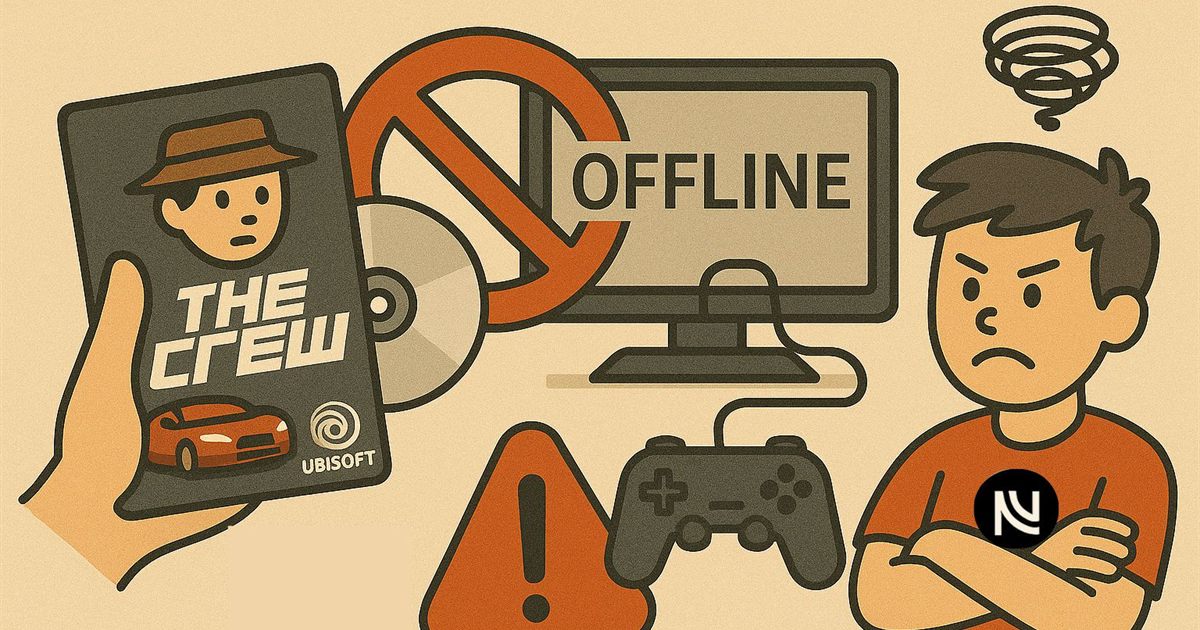
You pay sixty euros, take a box home and assume the game is yours. Ten years later the company switches off the servers and the disc will not start. The industry's answer has been as clear as it is uncomfortable: you did not buy the game, you bought a licence. Legally, that is true. The interesting question is a different one: were you told with the clarity the law requires?
What you actually buy
Traditionally, buying a physical game meant assuming you were acquiring ownership and the right to play indefinitely. That intuition was not entirely accurate even then, but it worked: the cartridge or the disc contained the whole game and nobody could stop you from running it.
With the rise of online games the model has changed. The consumer acquires an access licence, valid in most cases as long as one condition — rarely given any prominence — is met: that the servers are active. The player does not hold the right to reproduce the digital copy of the video game; what they receive is a permission made conditional by the rights holder.
It helps to separate two things that are constantly mixed up. One is ownership of the media: the disc is yours; you can sell it or give it away. The other is the right to run the program, which is a power belonging to the intellectual property holder and which extends only as far as the licence says. When the game does not work without a server, the first becomes irrelevant: you have the box and you do not have the game.
The case that put everything on the table
In November 2024, two players filed a class action in the United States against Ubisoft over the shutdown of the servers of The Crew, an open-world driving game released in 2014 that required a permanent connection. The claimants had bought physical copies in 2018 and 2020 believing they would be able to play freely. In April 2024 the company switched off the servers and the game became completely unusable.
The accusation was not that Ubisoft could not shut down the servers. It was that it had misled consumers into believing they were buying a complete game when in fact they were acquiring a limited licence.
Ubisoft's answer and why it is legally correct
The company responded by maintaining that players had never acquired ownership of the title, only a limited access licence. The line went viral and went down badly, but from an intellectual property standpoint it is accurate.
The holder of the rights in a video game retains the exploitation rights over it. Deciding how long to keep a server infrastructure running is, in principle, a business decision that falls within those rights. There is no general obligation in our legal system to keep an online service operating indefinitely.
Put another way: anyone disputing that the purchase of an online video game transfers ownership of the software is fighting a losing battle. The real debate lies elsewhere.
So where is the problem?
The core of the conflict is the information. If the relationship between the player and the company is a temporary licence conditional on the existence of a service, that is an essential characteristic of the product. And essential characteristics must be communicated clearly, comprehensibly and before the contract is concluded.
The industry's problem is not that it sells licences. It is that for years it has sold them with the language, the commercial presentation and the packaging of a purchase of ownership: a box on a shelf, a one-off purchase price, a button that says “Buy” and not “Rent” or “Subscribe”. The predictable consequence is that the average consumer understands they are buying something of their own, for good.
When the servers shut down, that gap between what the consumer understood and what they legally acquired is what gives rise to the claim. And it is far more uncomfortable ground for the company than ownership is.
What Spanish consumer law says
In Spain the applicable framework is not intellectual property law but consumer law. The Spanish Consumer Protection Act (texto refundido de la Ley General para la Defensa de los Consumidores y Usuarios) requires the trader to provide the consumer, before they are bound by the contract, with truthful and sufficient information on the main characteristics of the goods, content or service.
That text was also amended to transpose Directive (EU) 2019/770 on contracts for the supply of digital content and digital services, which introduced a regime of its own for digital content: conformity requirements, supply in accordance with what was agreed, and liability of the trader when what is delivered does not match what was promised. It is the rule that turns “what you advertised” into a legal criterion and not merely a commercial one.
Three perfectly identifiable lines of attack follow from this:
- Insufficient or misleading pre-contractual information about the temporary nature of access. If that temporary nature is essential and was not clearly disclosed, there is a problem.
- Unfair commercial practices by omission, where relevant information the consumer needs in order to decide is withheld.
- Unfair terms, where the terms and conditions allow the trader to terminate the service unilaterally, without reasonable notice or anything in return, creating a significant imbalance to the consumer's detriment.
None of the three disputes that a licence was sold. All three dispute how it was sold.
The open fronts in Europe
The matter has ceased to be an isolated lawsuit in the United States.
In France, UFC-Que Choisir, the country's most influential consumer association, sued Ubisoft for misleading commercial practices and unfair terms. It is a separate front from the American one and is framed in terms of European consumer law, which is the same framework that applies in Spain.
In parallel, the Stop Killing Games movement, born precisely out of this conflict, has managed to take the debate to the European institutions through a citizens' initiative. Its proposal is more ambitious than the lawsuits': it does not dispute the information; it demands that games sold be left in a working state when the publisher decides to withdraw support.
It pays to be cautious in assessing that last point. A citizens' initiative is not a law, and there is a considerable distance between public debate and an enforceable legal obligation. But it shows which way the regulatory wind is blowing, and that direction points towards preservation and transparency.
What a studio or publisher should do
All of the above has a fairly specific practical translation, and none of these measures costs money. They cost resolve.
- Inform clearly and transparently of the conditions of the licence granted with the purchase, including its dependence on an online service.
- Make that information visible and accessible at several points before the purchase: on the store page, on the download platform and within the payment process itself. A single mention buried in the terms and conditions does not fulfil the informative function.
- Plan balanced compensatory measures in advance for a shutdown scenario: credit towards other games, additional content or discounts on future titles. Having them provided for in the contract is far cheaper than negotiating them in the middle of a crisis.
- Set a reasonable notice period. Much of the reputational and legal damage comes not from the shutdown, but from the surprise.
- Consider an offline mode. If the game supports a serverless mode, offering it at shutdown turns the problem into a gesture. It is the answer the preservation movement is calling for and, technically, it is not always as expensive as claimed.
The conclusion for anyone publishing is the same as in any other consumer dispute: the risk is not in what you sell; it is in what the buyer understood you were selling them.
Frequently asked questions
▸Do I own the video game I buy?NPC
▸Can they shut down the servers of a game I have paid for?NPC
▸So can I claim anything if the servers are shut down?NPC
▸Does it make any difference if I bought a physical copy in a shop?NPC
▸What is Stop Killing Games?NPC
▸What do I have to disclose if I am the publishing studio?NPC
Sources
- Texto refundido de la Ley General para la Defensa de los Consumidores y Usuarios, the Spanish Consumer Protection Act (BOE)
- Directive (EU) 2019/770 on contracts for the supply of digital content and digital services (EUR-Lex)
- Real Decreto Legislativo 1/1996, the Spanish Intellectual Property Act (BOE)
- UFC-Que Choisir, action against Ubisoft
At NN Agency we advise studios and publishers on publishing, co-development and licensing contracts, ongoing legal counsel and litigation over breach of contract, including the terms of use and the licence conditions the player sees.
Facing something similar at your studio? The first consultation is free.
Free consultation