
Are tattoos copyrighted? Video games and the NBA 2K cases
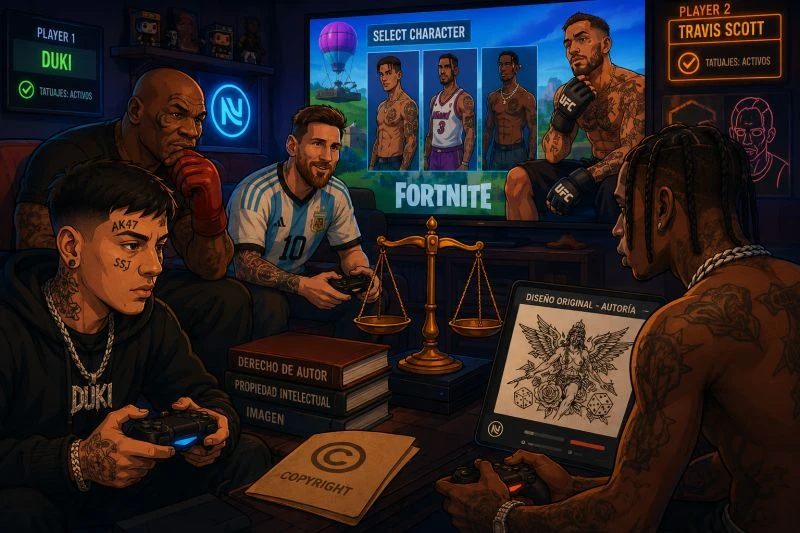
What happens when a video game faithfully reproduces a real person's tattoos? Sports games scan players down to the millimetre, fighting games recreate fighters with every line of ink, and the big platforms sell skins of musicians and footballers with their tattoos included. Behind each of those designs there is a tattoo artist, and the question is inevitable: can they claim copyright over their designs inside the game? The short answer is that a tattoo can indeed be a protected work, but the tattoo artist does not always win. Everything depends on whether the game is exploiting their work or the image of the person wearing it.
Why the question is no longer theoretical
Twenty years ago an athlete in a video game was a generic doll with their name on it. Today it is a digital twin: facial scanning, motion capture and, of course, their tattoos. Basketball, football and fighting simulators compete precisely on realism, and platforms like Fortnite have turned real footballers and musicians (from Neymar to Travis Scott) into playable skins that are bought and shown off.
The result is that three different rightholders coexist in the same product: the studio making the game, the famous person licensing their image and the tattoo artist who created the drawing that person wears on their skin. The first two almost always have a contract with each other. The third is almost never at the table.
Are tattoos copyrighted?
Yes, if they meet the usual requirement: originality. Spanish law protects all original artistic creations expressed by any means or medium (article 10.1 of the Intellectual Property Act), including drawings and works of visual art. A tattoo created by the artist is, in essence, a drawing whose medium is skin, and it qualifies as an autonomous artistic creation, just like an illustration or a graphic design. Its author is the tattoo artist, who holds moral rights over it (such as recognition of authorship or the integrity of the design) and economic rights (reproduction, distribution, communication to the public and transformation).
Not every tattoo is a work, though. Generic or catalogue motifs (the basic rose, the standard tribal) are not, and neither is a mere copy of someone else's work: if someone gets a video game character tattooed, the artist creates nothing protectable, they reproduce someone else's character. And there is one more nuance that matters for everything that follows: the law separates copyright from ownership of the physical thing in which the work is incorporated (article 3). In other words, wearing the tattoo does not make the wearer the owner of the rights over the drawing, just as buying a painting gives no right to print T-shirts with it.
The clash: the tattoo artist's copyright and the right to one's image
The conflict arises when that work is permanently incorporated into the body of a person whose image is publicly or commercially exploited. That person in turn has a fundamental right to their own image (article 18.1 of the Spanish Constitution), developed by Organic Law 1/1982: using their image for commercial purposes requires their express consent (articles 2.2 and 7.6). That is exactly what the game buys when it licenses an athlete, directly or through their league or players' union.
In these cases, if that person is exploited in a video game, the legal question becomes whether the game:
- Is autonomously exploiting the tattoo artist's artistic work, or whether, on the contrary,
- Is legitimately reproducing the image of the tattooed person, with the tattoo as an accessory element inseparable from that representation.
All of this puts us before a genuine balancing of rights. On one side, the tattoo artist, who may allege an unauthorised reproduction or communication to the public (and, where applicable, a transformation) of their work. On the other, the person's right to exploit their own image, especially when the tattoo is a permanent part of their physical appearance. Requiring the tattoo artist's permission for a footballer to appear as he is would mean, taken to the extreme, that his own face was no longer only his.
What the courts have said
Most of the litigation has been in the United States, and its case law is a good map of the problem (with the caveat that the US system includes doctrines, such as fair use, that Spanish law does not):
- Mike Tyson's tattoo (2011). The artist behind the boxer's famous face tattoo sued Warner Bros. because The Hangover Part II copied it onto another actor. The judge let the film open, but considered the artist had a good chance of winning, and the case ended in a confidential settlement. Note the detail: Tyson was not being reproduced, the design was reproduced on another person, which is autonomous exploitation of the work.
- NBA 2K, Solid Oak Sketches (2020). A New York court sided with the game against the company that had acquired the rights to the tattoos of LeBron James and other players: minimal use within the game, fair use and, above all, implied licence. The artists knew the players would appear in public, on television and in products using their likeness, and had implicitly authorised them to display the tattoos.
- WWE 2K, Alexander (2022 and 2024). In the opposite direction, an Illinois jury sided with wrestler Randy Orton's tattoo artist and rejected fair use. However, the 3,750-dollar award was set aside in 2024 because she proved no economic harm: she won the case but collected nothing.
- NBA 2K, Hayden (2024). An Ohio jury closed the circle in favour of the game: there was an implied licence to show LeBron James's tattoos, flowing from the agreement to use his image in the game.
The balance is clear. When the tattoo appears as part of the person's licensed image, the game usually wins. When the design is used apart from that person, the tattoo artist has a serious case.
How a Spanish judge would decide it
We are not aware of any Spanish judgment on tattoos in video games yet, but Spanish rules offer two tools that lead to the same solution.
The first is implied authorisation. When a contract does not specify what is assigned, Spanish law limits the assignment to what necessarily follows from the contract itself and is indispensable to fulfil its purpose (article 43.2). The purpose of commissioning a tattoo is for the person to wear it and show it. So when a tattoo artist knowingly tattoos a person with a public profile, there is at least an implied authorisation for the ordinary uses inherent in the public exploitation of their image. And today, with digital exposure intensified by social media, it can be argued that the authorisation reaches their inclusion in broadcasts, advertising campaigns, documentaries and digital recreations such as a video game. It is a defensible thesis, not a written rule: the same article 43 construes assignments restrictively, and the tattoo artist will argue that the video game was not part of the deal. That is why the second tool weighs so much.
The second is balancing. Spain's Supreme Court has already said the author's right is not absolute when the work is incorporated into someone else's medium: in its judgment of 18 January 2013 (ECLI:ES:TS:2013:371), on a municipal sculpture, it held that the author's right must be coordinated with that of the owner of the medium, exercised in good faith and without imposing disproportionate sacrifices, and that the decision requires weighing the specific case (it is the same judgment we analysed regarding film adaptations). If that holds for a sculpture on a roundabout, all the more so when the "medium" is a person with fundamental rights.
Consequently, in practice the tattooed person's right to commercialise and license their image tends to prevail. That does not mean, however, that the tattoo artist automatically loses all their rights.
The line: accessory use or autonomous exploitation
The game's defence is strong when the tattoo appears in a way that is:
- Accessory: the tattoo is not the product's hook, the person is.
- Integrated: it appears where and as it is on the real body.
- Inseparable from the representation of the real person.
- Not autonomous: the design is not exploited as an artwork in itself.
And the tattoo artist's case is perfectly arguable when the design is exploited independently, for example:
- Merchandising centred only on the design (T-shirts, cases, posters of the tattoo).
- Isolated reproduction of the tattoo: a loading screen, a promotional close-up or a menu background built on the drawing rather than on the person.
- Autonomous sale inside the game: the tattoo as a cosmetic item sold or applicable to any avatar, which is exactly what happened in The Hangover Part II, taken to the video game.
- Promotional use separate from the tattooed person.
There is also a front people forget: the tattoo artist's moral right. If the studio decides to alter the design (simplifying, recolouring or cropping it for the 3D model), it may touch on their right to the integrity of the work, and recognition of authorship remains theirs even if the game holds a licence. We looked at this in detail regarding mods built on someone else's game: modifying another's work always has a limit.
What to do depending on your position
- If you are a studio: in image licence agreements, ask the athlete or artist for an express warranty on their tattoos (that they can authorise their reproduction as part of their image, or that they will bear the tattoo artist's claim). Inventory the visible tattoos of the main figures. And never exploit the stand-alone design (cosmetics, merchandising, promotion) without the tattoo artist's licence.
- If you are an athlete, fighter or artist: your image is your business. Before getting something large and visible tattooed, a simple document with the tattoo artist authorising the uses of your image (including video games and digital recreations) is worth it. Cheap before, expensive after.
- If you are a tattoo artist: document your original designs and their date, and make clear in your commission that you authorise your client's image uses but reserve the independent exploitation of the design. It is the line the courts are already drawing, and it should be on your paper too.
Frequently asked questions
▸Are tattoos copyrighted?NPC
▸Can I get a video game character tattooed without infringing?NPC
▸Who owns the rights to a tattoo: the artist or the person wearing it?NPC
▸Can a video game reproduce a footballer's or a fighter's tattoos?NPC
▸Can a tattoo artist sue a video game?NPC
▸What happened in the NBA 2K tattoo lawsuits?NPC
▸Can a studio remove or change a player's tattoos in the game?NPC
▸Are there copyright-free tattoos?NPC
▸What is an implied licence for a tattoo?NPC
Sources
- Spanish Intellectual Property Act, Royal Legislative Decree 1/1996, articles 3, 10, 14 and 43 (BOE)
- Organic Law 1/1982 on the civil protection of honour, privacy and one's own image, articles 2 and 7 (BOE)
- Spanish Constitution, article 18 (BOE)
- Spanish Supreme Court judgment of 18 January 2013 (CENDOJ, ECLI:ES:TS:2013:371)
- Solid Oak Sketches v. 2K Games, summary of the 2020 decision (Loeb & Loeb)
- Alexander v. Take-Two: tattoo artist wins, but gets zero damages (Technology & Marketing Law Blog)
- 2K wins the lawsuit brought by LeBron James's tattoo artist (VGC)
- The Hangover Part II tattoo settlement (ABA Journal)
At NN Agency we work all three sides of this table: we help studios license the image of athletes and artists without surprises, athletes, artists and tattoo artists protect their image and their designs and everyone resolve the claim when it arrives. If your game recreates real people (or your designs appear in one), let's talk: the first consultation is free.
Facing something similar at your studio? The first consultation is free.
Free consultation