
Can I freely promote the part of the game I contributed to?
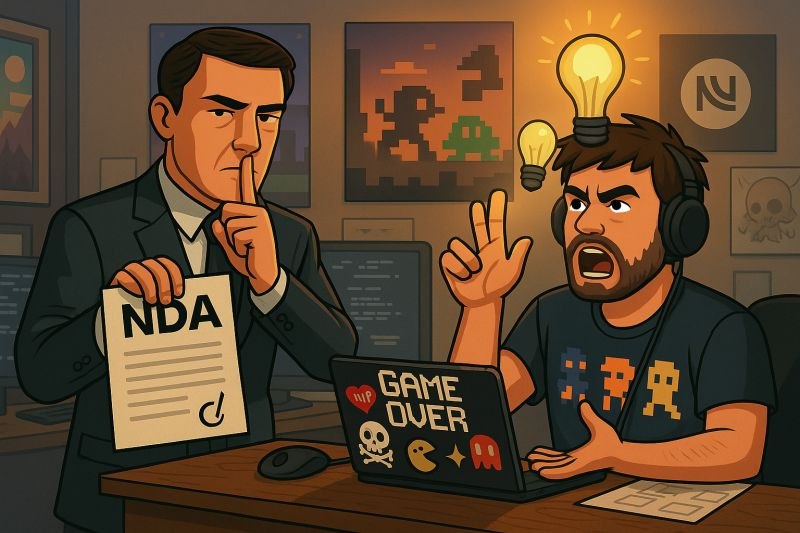
The dispute between the co-founders of Playdead, the Danish studio behind titles like Limbo and Inside, reaches the courts: Dino Patti has confirmed that Playdead is suing him for posting on social media an internal image from Limbo's development along with commentary on the creative process. The claim is that Patti used copyright-protected materials without authorisation, breaching the confidentiality agreements signed after leaving the company in
- Patti, for his part, defends his right to be publicly recognised for his original
contribution to the game's creation, a moral right regarded as inalienable in Europe. And in that clash sits the question that matters to any developer: where does your right to tell what you did end, and where does what you signed begin?
The case: Playdead versus its co-founder
Dino Patti co-founded Playdead and was its CEO during the development of Limbo, one of the most influential independent titles of its generation. He left the company in 2016. In late 2024 he posted on LinkedIn an internal image from Limbo's development along with an account of the creative process, and in March 2025 he received a formal claim from the studio: removal of the content and 500,000 Danish kroner in compensation, for unauthorised use of copyright-protected materials and of the studio's trade marks (which also appeared, in their characteristic lettering, on his CV). The claim ended up as a lawsuit.
Patti maintains he was only exercising his right to be recognised for his contribution to the game's creation; the studio, that he disclosed internal material that does not belong to him and was covered by the confidentiality commitments given on his departure. Both accounts can be partially true at the same time, and that is precisely the legal interest (and difficulty) of the case.
The two questions the conflict raises
The conflict raises two questions relevant to the industry's developers (and to creators in general):
- How far can I promote my work when it is integrated into a whole owned by the company?
- Can I exercise my right to be recognised as an author at any time, based on the moral right of attribution, or does the confidentiality I signed prevail?
Although the case will be heard by Danish courts, both questions get the same answer under Spanish law, because the pieces (inalienable moral rights, assignment of economic rights, agreed confidentiality) are common to the continental European framework.
The video game as a complex work
Video games are regarded as complex works made of multiple contributions: software, art, music, script, design. In most cases that produces two consequences worth keeping always in view:
First: even though each contribution is individually protectable if original, all of them are integrated into a single unit of exploitation, generally managed by the producing company or project owner. What matters, therefore, is not only whether a developer created an original part, but how their contribution and their right to disclose it were regulated by contract.
Second: the assignment of economic rights usually comes accompanied by confidentiality agreements which, under freedom of contract, legitimately restrict the public communication of development materials and processes outside the channels set by the company.
It is the same logic we saw regarding the video game's chain of title: the game works commercially because all contributions converge on a single owner. The other side of that coin is that no individual contributor, however important, can dispose of the whole.
The moral right of attribution: what it really covers
Spanish law (article 14.3 of the Intellectual Property Act) recognises the author's right to demand recognition of their authorship of the work. It is a moral right: it cannot be waived or transferred. No contract can assign it away, buy it or extinguish it, however many NDAs are signed. On that point, Patti is right.
But it pays to measure what exactly that right protects: it protects the credit. It lets you demand that your name appear as the author of your contribution, oppose anyone claiming your work as theirs, and say publicly "I was the executive producer of this game".
What the right of attribution does not give you is a right of public communication over the work's materials: showing internal builds, unpublished art, design documentation or images of the development process. Those materials carry their own exploitation rights, and their owner decides whether they are disclosed. Saying "I made this" and showing "this" are, legally, two different acts.
The NDA: how far it can legitimately restrict
Confidentiality agreements live off freedom of contract: the parties may agree whatever they wish as long as it does not contravene the law or public policy. An NDA prohibiting the disclosure of internal materials and development processes outside the company's channels is a perfectly legitimate covenant, including after an employee's or partner's departure, as we explained regarding studio know-how.
What an NDA cannot do is suppress the moral right: a clause prohibiting a developer from identifying as the author of their contribution would be void on that point, because the right of attribution is not disposable. The NDA governs the territory of materials and information; the moral right, the territory of credit. Conflict arises when someone crosses from one territory into the other believing they are still in their own.
When the moral right and the NDA collide
And that is exactly the crux of the Playdead case. Although the moral right to be recognised as an author is inalienable and cannot be waived, it does not prevail over validly signed confidentiality commitments when what is disclosed is not the name or the credit, but internal information or unauthorised content. In that scenario we are not looking at the exercise of a moral right, but at a breach of contract generating liability for damages.
Put with the case's own example: Patti can say, wherever and whenever he wants, that he co-founded Playdead and was an essential part of Limbo's creation. What is in dispute is something else: whether he could publish an internal development image, material whose exploitation rights do not belong to him and which was covered by his exit commitments. The moral right shields the former; hardly the latter.
The 67,000 euros: what will be argued about the amount
Another point of debate will be the proportionality of the 500,000 kroner claimed (around 67,000 euros) for a social media post. There, the outcome will hinge on a factor that deserves attention:
If what was disclosed affects intangible assets owned by the company (and Patti cannot prove that his contribution is original enough to qualify as his own work with which to illustrate his account), the amount has more mileage than it seems: on top of the breach of contract can come copyright infringement, for the unauthorised reproduction and public communication of the material, and trade secret violation if the internal content had value precisely because it was not public. Each route carries its own compensation regime, and together they explain figures that look disproportionate at first sight for "a photo on LinkedIn".
If, on the contrary, the disclosed material is held to be Patti's own original contribution, or to lack real confidential value, the claim loses muscle and the amount loses its footing.
How to promote your work without getting sued
The balance between professional recognition and legal limits is not simple, but it is manageable. Our practical guide for developers:
- Claim the credit, not the materials. Saying what you did is your right; showing unpublished internal material almost never is.
- Use what is public. Trailers, official screenshots, the credits, press coverage: everything the studio already released is safe ground for illustrating your portfolio.
- Reread your contract and your exit agreement before posting. What you assigned, what you kept and which communication channels were agreed. If your exit was contentious, all the more reason.
- Ask for written authorisation for anything not public. Many studios grant it without fuss for portfolios and talks; asking costs an email, not asking can cost 67,000 euros.
- If you are a studio, regulate this in advance: a portfolio and public communication policy in contracts and exit agreements prevents exactly this lawsuit, in both directions.
This trial may end up being a reminder for the whole industry: being an author does not mean having carte blanche to disclose without control what was created within a contractual framework.
Frequently asked questions
▸Can I say publicly which video games I have worked on?NPC
▸Can I show internal development material in my portfolio?NPC
▸Doesn't the moral right of authorship override what I signed?NPC
▸What exactly is Dino Patti accused of in the Playdead case?NPC
▸Does an NDA signed years ago still bind me?NPC
▸How do I showcase my work if I cannot use internal material?NPC
▸I run a studio. How do I avoid ending up in a dispute like this?NPC
Sources
- Spanish Intellectual Property Act, Royal Legislative Decree 1/1996, article 14 (BOE)
- Spanish Civil Code, article 1255 (BOE)
- Spanish Trade Secrets Act, Law 1/2019 (BOE)
- PC Gamer: Playdead demands compensation from co-founder Dino Patti
- 80 Level: Playdead has filed a lawsuit against its co-founder
At NN Agency we help studios and developers with intellectual property and ownership of contributions, the drafting and review of contracts and confidentiality agreements and infringement and breach disputes. If you are unsure about what you can publish (or about what a former collaborator is publishing), talk to us before it becomes a lawsuit.
Facing something similar at your studio? The first consultation is free.
Free consultation