
Are the prices of in-game assets shown inside a video game accurate?
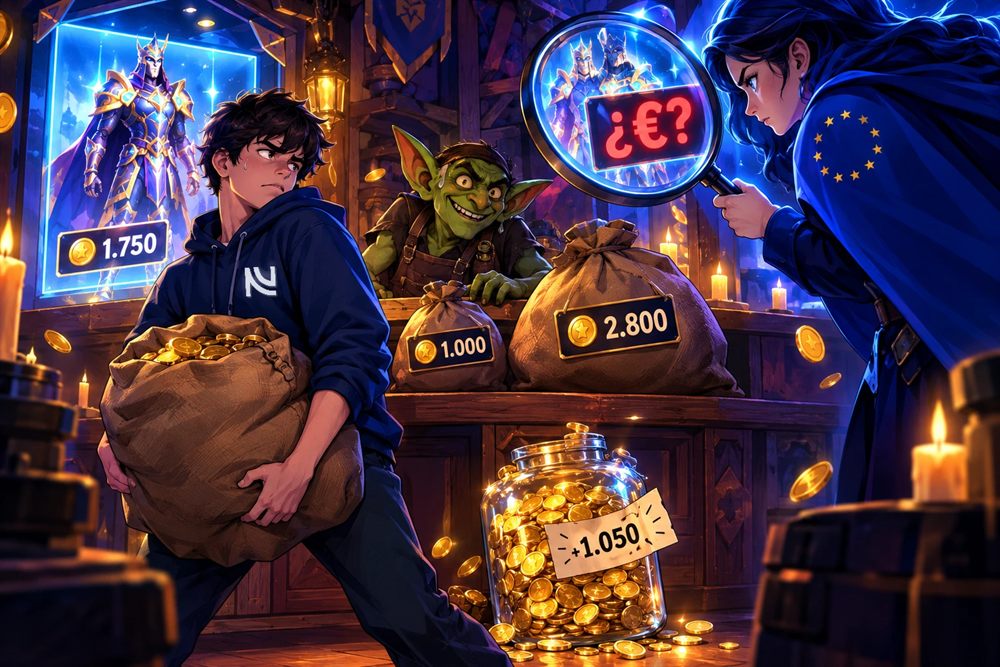
A skin costs 1,750 coins. Coins come in packs of 1,000 and 2,800. To buy the skin you have to buy the big pack, you are left with 1,050 coins you cannot use for anything you want, and at no point have you seen a price in euros. That scene, repeated across millions of play sessions, is the one the European Union has decided to end. On 30 September 2026 the Consumer Protection Cooperation Network (the CPC Network) announced eleven coordinated actions against ten companies over their practices with in-game virtual currencies: Minecraft, Candy Crush Saga, Valorant, Clash of Clans, For Honor and other titles with hundreds of millions of players. There is no new law behind it. There is something more uncomfortable for the sector: the consumer law of always, finally applied to abusive microtransactions.
What happened: from principles to actions
The CPC Network brings together the national consumer authorities of the EU and the European Economic Area and acts in a coordinated way against cross-border infringements under Regulation (EU) 2017/2394. Its history with video games has three chapters:
- March 2025. The Network publishes its key principles on in-game virtual currencies and opens an action against the Swedish studio behind Star Stable Online, a game hugely popular with children. Behind it was a coordinated complaint by consumer organisations from 17 countries, filed in September 2024.
- June and September 2025. Two Commission workshops with the industry organisations (Video Games Europe and the European developers' federation) to discuss how to apply the principles, followed by written exchanges.
- 30 September 2026. The Network adopts its Joint Statement on Stronger Consumer Protection in Video Games and announces eleven coordinated actions. Its diagnosis leaves no room for doubt: it has found indications that "a high number of video game companies have not made any substantive changes to their video games" either through the public guidance or through the talks of the past years. And it adds a sentence the sector should frame: self-regulation initiatives such as PEGI "have brought some positive changes for consumers, but they often fail to address the core of harmful practices".
The games chosen are no accident. The Statement itself explains they were selected for their broad reach, cross-device accessibility and varied age ratings: Hunt: Showdown 1896 (Crytek), Forge of Empires (InnoGames), Candy Crush Saga (King), Minecraft (Mojang), Mech Arena (Plarium), Gardenscapes (PLR Worldwide Sales), Valorant (Riot), Clash of Clans (Supercell) and For Honor (Ubisoft), plus Diablo Immortal and Call of Duty Mobile in the action against Activision Blizzard opened in early 2026.
The CPC's seven principles, one by one
The starting idea is simple: every purchase made with a virtual currency bought with real money is subject to consumer law. From there, the principles:
- Clear and transparent pricing: the price of digital content must be shown in real money (euros, in our case), not only in in-game currency.
- No practices that hide the cost: no currencies bought with other currencies, no exchange rates that prevent working out what something costs.
- No forced over-purchasing: players cannot be pushed into buying more currency than they need because packs do not match prices.
- Clear pre-contractual information, before paying.
- Right of withdrawal: cancelling the purchase and getting the money back for unspent currency, unless validly waived.
- Fair and comprehensible terms, in plain language.
- Protection of vulnerable groups, especially minors.
If you have read our Top 5 legal conflicts of 2026, you will recognise number three on that list. What was then a risk on the horizon is today an open file for ten companies.
The case that opened the way: Star Stable
The Network's common position on Star Stable Online (21 March 2025) is the best manual of what not to do, because it describes concrete practices the Network considered contrary to consumer law and particularly harmful to children:
- Direct exhortations to children in advertising to buy currency or items, or to persuade adults to buy for them.
- Pressure techniques such as "limited-time" purchases to unduly influence children.
- Lack of clear, child-adapted information on buying and using the virtual currency, leading to spending more than intended.
- Influencers promoting the game without clearly disclosing commercial content.
The company was given time to respond in writing and propose commitments. The Commission has not published the outcome to date, but the list of practices is the one replicated in the common positions against the ten companies of September.
Which law regulates microtransactions in Spain (and why no new one is needed)
Here is the point that most confuses studios: there is no virtual currency law. The Network applies four directives in force for years (unfair commercial practices, consumer rights, unfair terms, and digital content and services), transposed in Spain into rules any online shop knows:
- The consolidated General Act for the Protection of Consumers and Users requires, before contracting, the full final price including taxes (Article 20.1.c) and, in distance contracts, the total price of the goods or services including taxes and charges (Article 97.1.e). A skin at 1,750 coins without its euro equivalent meets neither.
- The purchase button must read "order with obligation to pay" or an equivalent, unambiguous wording (Article 98.2). Otherwise the consumer is not bound.
- The Unfair Competition Act treats as misleading the false claim that a product will only be available for a very limited time in order to induce an immediate decision (Article 23), and as aggressive including in advertising a direct exhortation to children to buy or to persuade their parents or other adults to do so (Article 30).
In other words: what the CPC Network has done is stop treating a shop inside a game as something other than a shop. As we explained when discussing what you really buy when you buy a game online, consumer law enters the game with the player.
The right of withdrawal and unspent currency
The principle the sector fears most is the fifth. The law grants the consumer the right to withdraw from the contract within fourteen calendar days without giving any reason (Article 102.1 of the consolidated Act). And for digital content not supplied on a tangible medium there is an exception almost every game shop misuses: the right is lost if performance has begun with the consumer's prior express consent and acknowledgement that they thereby lose the right of withdrawal (Article 103.m).
The practical consequence is twofold. First: bought and unspent currency is the player's money for 14 days, and they must be able to recover it unless they validly waived. Second: the waiver must be express and informed, not a line in the terms. A clear box before the currency is spent ("I understand that by using the coins I lose my right to return them") solves the problem. Treating the right as waived because the player opened the game does not.
Children, timers and influencers
The seventh principle weighs most in the September actions and in the Activision Blizzard action, which besides currencies examines addictive design, preselected parental controls, direct exhortation to children and unilateral account blocking. Three practices concentrate the risk:
- Timers and scarcity: the Joint Statement expressly cites "misleading countdown timers and unfounded scarcity claims" among the techniques that harm consumers. An offer that "ends in 2 hours" and repeats every day is a false claim of limited availability.
- Messages to children: any "buy it now!" aimed at a child audience, or a game character asking the player to persuade their parents, is the aggressive practice the law bans in so many words.
- Influencers: the studio answers for those promoting the game identifying commercial content. The Commission maintains an Influencer Legal Hub precisely because responsibility climbs up to the brand.
All of this connects with what already binds your studio on minors, with what age rating already requires (the new PEGI criteria) and with what is coming in the future KIDS Act. The Network's Statement adds, in case there was any doubt, that it pays "particular attention" to variable reward systems (loot boxes), "especially where such systems are directed at, or made available to, children".
What happens now with the ten companies
The CPC procedure is gradual. The Network has opened an individual dialogue with each company on its common position and expects concrete commitments. If the problems are not corrected, national authorities (in Spain, the Directorate-General for Consumer Affairs and the regional authorities) may adopt enforcement measures under their own sanctioning regime. There is no sanction and no finding of infringement yet, and it is important to say so: what there is are indications and a demand for change.
The message for the rest of the sector, though, is in the Statement itself: the Network "calls on all companies active in the video gaming sector to review their practices" in light of the existing common positions and of those to be published in the future. The ten companies are the example, not the limit.
What your game must change
Our recommendation, in order of urgency:
- Euros next to every price expressed in virtual currency, in the in-game shop and on the confirmation screen. It is the most visible change and the one authorities look at most.
- Packs that add up: let the player buy exactly what they need, or at least not be forced into a structural surplus. If the game's economy depends on the leftover, the game's economy has a legal problem.
- Withdrawal done properly: 14 days for unspent currency and an express, informed waiver before spending it. The button, with "order with obligation to pay".
- Pressure audit: timers, "last units" offers, character messages asking to buy, notifications. Whatever cannot be defended as true, out.
- Influencer protocol with the duty to identify advertising written into the contract.
- Minor mode: if the game is accessible to minors, no exhortations to buy and purchases subject to parental controls active by default.
Doing this now costs a few weeks of design. Doing it after a CPC common position costs the same plus a file.
Frequently asked questions
▸What has the European Union done about in-game virtual currencies?NPC
▸Is it illegal to sell virtual currency in a video game?NPC
▸Do games have to show the euro price of skins and items?NPC
▸Can I get a refund for virtual currency I have not spent?NPC
▸Which games are being investigated by the EU?NPC
- Before that, in March 2025, Star Stable Online.
▸Why do games show prices in V-Bucks or Robux and not in euros?NPC
▸What are abusive microtransactions according to the EU?NPC
▸Which law regulates microtransactions in Spain?NPC
▸What happens if a company ignores the CPC's requests?NPC
Sources
- CPC Network, Joint Statement on Stronger Consumer Protection in Video Games, 30 September 2026 (European Commission)
- CPC Network, Key Principles on In-Game Virtual Currencies, 21 March 2025 (European Commission)
- European Commission, coordinated actions on social media, online games and search engines (official CPC page)
- European Commission press release on the Star Stable action and the key principles, 21 March 2025
- Spanish Royal Legislative Decree 1/2007, consolidated consumer protection Act, Articles 20, 97, 98, 102 and 103 (BOE)
- Spanish Act 3/1991 on Unfair Competition, Articles 23 and 30 (BOE)
At NN Agency we review with studios their game's shop and economy against consumer law, draft their terms, notices and influencer contracts and stand by them if a request from an authority arrives. If your game sells virtual currency, the list in this article is your next meeting: the first consultation is free.
Facing something similar at your studio? The first consultation is free.
Free consultation