
Can your stream be stopped because of the music playing on the radio of the very game you are streaming?
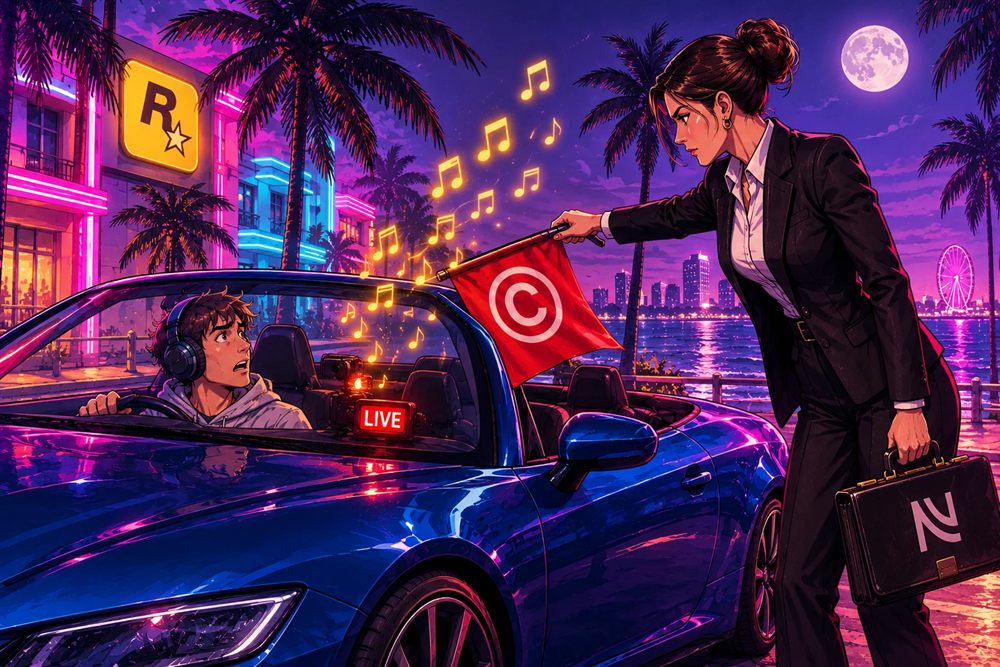
GTA 6 goes on sale tomorrow and thousands of channels will stream it from the first minute. Guides on GTA 6 copyright and streaming have been circulating for weeks, and nearly all of them give the same advice, turn the radio off. The answer to the question in the title is yes, it can, although it will rarely be Rockstar that does it. Rockstar tolerates streams of its games, on terms it can change whenever it wants, and streams give it free publicity. The one who can file a claim is the owner of each song on the radio, because the music does not belong to Rockstar and its permission, unless it has agreed otherwise with the rightholders, does not reach it. And on YouTube what is usually at stake is the money the video earns, rather than the channel.
GTA 6 copyright, why the in-game radio worries creators
The series has always stood out for its radio stations, with dozens of commercial songs that start playing the moment the player gets into a car. For the player it is part of the charm. For anyone streaming it is the source of most notices, because platforms' detection systems recognise those songs just as they would in any other video.
In the weeks before launch, guides explaining how to stream the game safely have multiplied. Some take for granted that it will ship with a creator mode that mutes licensed music, like the one other titles have included. At the time of writing there is no official announcement from Rockstar confirming it, so it is unwise to count on it until it shows up in the game's settings.
What is published, and hardly anyone reads, is Rockstar's policy on videos and streams and each platform's copyright rules.
Is it legal to stream games?
Only with authorisation. A video game is a protected work, and Article 17 of Spain's Intellectual Property Act reserves to the rightholder the rights of reproduction and communication to the public, which may not be carried out without their authorisation. A live stream is communication to the public, which Article 20 defines as any act by which a plurality of persons may have access to the work without prior distribution of copies to each of them. The saved video is, in addition, a making available.
Buying the game changes none of this. A game licence is for playing it, not for broadcasting it.
Many creators believe quotation rights or fair use protect them. Fair use is a doctrine of United States law that does not exist in Spain. The quotation exception does exist, but Article 32 of the Act limits it to including fragments of others' works by way of quotation or for analysis, comment or critical assessment, and adds that such use may only be made for teaching or research purposes. A full commented playthrough does not fit.
If game streams exist it is because publishers want them. They are free advertising, which is why nearly all publishers post terms authorising or tolerating streams of their games. Those terms act as the creator's licence, and they should be read the way a contract is read.
What Rockstar allows when you upload or stream its games
Rockstar's policy on the use of its material was last updated on 10 January 2025 and applies to all its games. It says Take-Two, its parent company, "does not object" to fans using its material for non-commercial uses in a manner that does not spoil the plot for others. Strictly speaking it is not a licence. It is a statement that it will not object.
Three details tend to go unnoticed.
- What non-commercial means. The policy defines it this way, "you don't make money through the game footage you post", nor use the material to promote a product or service. Read literally, it leaves out a monetised channel. Monetised streams of its games are commonplace, which means professional creators work on a tolerance, not on a right.
- It can be withdrawn. Take-Two "reserves the right to have its copyrighted material taken down at any time", and warns that the list of what is prohibited is not exhaustive and that the policy may change.
- What is certain to be removed. Footage from copies obtained before the official release date, however they were obtained. Videos showing the ending or stitching the story cutscenes together. The in-game TV shows and comedy performances posted in isolation. Videos showing cheats in online modes and those promoting unauthorised mods or ports.
Showing cutscenes as part of a larger playthrough or a narrated video is allowed, according to the text itself.
The policy ends by saying it is intended for occasional, non-commercial use by fans, and that it does not apply to the exploitation of its games in film, on television or on film and series platforms, in music videos, in advertising or in publishing. That exclusion does not cover players' streams, because the same policy takes for granted that they are broadcast on video sites and sets conditions for them. Anyone using game footage in a campaign for a brand has to request a licence, and that includes a creator doing a sponsored stream.
GTA 6 music, the problem that does not depend on Rockstar
Rockstar's policy does not mention music once. The songs on the stations are not its own. They belong to their authors, their publishers and the record labels, who have licensed them to Rockstar for a specific use, including them in the game. Unless Rockstar has agreed otherwise with them, its permission does not reach the music.
If the same case arose in Spain, the rule is in Article 43 of the Intellectual Property Act. An assignment of rights is limited to the forms of exploitation expressly provided for. In other words, a label authorising a studio to put a song in its game does not authorise a third party to broadcast it on their channel, unless the contract says so. The same happens with music a studio commissions, as we saw in whether a freelance composer can stop their soundtrack from being commercialised.
That said, Rockstar's contracts with the labels are not public, and they are most likely governed by United States law, where Rockstar Games and Take-Two are based. We do not know what they say. What we do know is that what Rockstar itself has published points to the same result as Spanish law, as the GTA V precedent shows.
That is why a notice can arrive even when Rockstar is delighted with the stream. The one claiming is the rightholder of the song, using each platform's automated tools.
There is a precedent that confirms it. For GTA V, Rockstar published another help page in April 2024 about videos made with the game's editor. It says the radio tracks included in that editor can be used in YouTube videos without fear of a copyright strike, but that the artists or labels may monetise those videos or restrict them in some countries, and it recommends the instrumental score to avoid that. In other words, even where Rockstar has agreed something, the rightholder of the song still decides. At the time of writing there is no equivalent page for GTA VI.
There remains the platform's own licence. Since 2021, platforms where users upload content are liable for what they offer and have to obtain authorisation from rightholders. Article 73 of Spain's Royal Decree-law 24/2021, which implements the EU Copyright Directive, says that authorisation also covers their users' acts, but on a condition that tends to be forgotten, namely that those users do not act on a commercial basis or their activity does not generate significant revenues. A platform's deal with the labels protects the hobbyist. It does not necessarily protect a channel that lives off its streams.
Claims and copyright strikes on Twitch and YouTube
Not all notices are the same, and confusing them leads to bad decisions.
YouTube. It distinguishes two things. A Content ID claim is automated. The system finds a match and applies whatever the rightholder has configured, which may be blocking the video, monetising it in their favour or simply tracking its statistics. The video is not removed and the channel does not get a strike. A removal request is something else. If the rightholder formally asks for the content to be removed and it is, the channel receives a copyright strike.
Twitch. Its guidelines say that when it receives a complete notification from a rightholder it generally removes or disables the recorded content, and may disable the livestream and suspend the account if the infringement is continuing at that moment. A notification counts as a strike if the creator does not file a complete counter-notification and the rightholder does not retract it, and with three strikes the account is terminated as a repeat infringer. Strikes are not permanent, and the platform may offer to remove one every twelve months to those who complete its copyright course.
In both cases there is a counter-notification, which is the way to object when the notice is a mistake. It is not a minor formality. Twitch warns that the details of whoever files it are forwarded to the claimant, who may go to court to keep the content down.
A copyright takedown is also not the same as a sanction by the game itself. If what is lost is the game account, the analysis is the one in whether a game company can ban you for no reason.
Your rights in Europe if your stream is taken down
Platform rules are written with United States law in mind, but a creator streaming from Spain also has what European and Spanish law give them.
- An explanation. Article 17 of the Digital Services Act requires the platform to give a statement of reasons for any restriction, whether removal of the video, suspension of the account or loss of monetisation.
- A free complaint. Article 20 of the same regulation gives them, for at least six months from the decision, access to an internal complaint-handling system, electronic and free of charge, against the removal, the suspension or the restriction of the ability to monetise.
- A deadline and a human. In Spain, Article 73 of Royal Decree-law 24/2021 requires complaints about content removal to be handled within ten working days and the decision to be reviewed by a person, without automated intervention. While the complaint is pending, the content does not go back up.
- Mediation. The same article gives the First Section of Spain's Intellectual Property Commission the role of mediator or arbitrator in these disputes.
Article 73 also says cooperation between platforms and rightholders must not prevent content made for the purposes of quotation, analysis, comment or criticism, review, parody or pastiche. Twitch reflects this in its guidelines, where it asks rightholders to take those exceptions into account before notifying.
At NN Agency we think this gives real room to an analysis or review video that uses fragments of the game, and very little to a six-hour stream with the radio on. A song playing in full in the background is not being quoted or commented on.
Before going live, a checklist for creators and for studios
For anyone about to stream the game.
- Read the publisher's policy before the first stream. What it allows, whether it accepts monetisation and what it removes.
- Check the audio settings. Turning off the radio and licensed music removes most of the risk. Not all of it, because there may be songs outside the stations, in missions or scenes.
- Do not replace it with other unlicensed music. Putting your own playlist on top swaps one problem for an identical one.
- Treat the saved video separately. The live stream and the video left behind are handled differently, and it is the second that accumulates claims.
- If a brand is involved, ask for a licence. A sponsored stream is a commercial use, and Rockstar's policy points to an express request.
- Keep everything if a notice arrives. Who is claiming, which song and at which minute. If it is a mistake, the counter-notification is what stops the strike from counting, but it has legal consequences and is worth weighing before sending it.
For a studio publishing a game the lesson is the reverse. Streams are its best advertising, and whether they can be done without surprises depends on the studio. At NN Agency we recommend three things. A video policy of its own that expressly says whether monetisation is allowed. Music licences that cover streaming by third parties, or a game mode that turns off the songs that do not. And contracts with composers that provide for that use from the commission onwards.
Frequently asked questions
▸Can you stream GTA 6 on Twitch or YouTube without copyright problems?NPC
▸Does GTA 6 have a streamer mode?NPC
▸Can you play copyrighted music on Twitch?NPC
▸What is a copyright strike?NPC
▸Can you monetise gameplay videos on YouTube?NPC
▸What should I do if my stream is taken down for copyright?NPC
▸Is crediting the artist enough?NPC
▸Is it legal to stream games under fair use?NPC
Sources
- Rockstar Games, Policy on posting copyrighted Rockstar Games material, last updated 10 January 2025
- Rockstar Games, Information About Being Safe From Copyright Strikes When Uploading Rockstar Editor Videos, last updated 3 April 2024
- Twitch, Digital Millennium Copyright Act Notification Guidelines
- YouTube Help, Content ID claims and copyright removal requests
- Spanish Intellectual Property Act, Articles 17, 20, 32 and 43, consolidated text, in Spanish
- Royal Decree-law 24/2021, Articles 66 and 73, consolidated text, in Spanish
- Regulation (EU) 2022/2065, the Digital Services Act, Articles 17 and 20, EUR-Lex
At NN Agency, as video game lawyers, we help studios license the music in their game and draft their video and streaming policy, close contracts with composers, content creators and brands and challenge a platform when it takes down what it should not have. If you are about to launch a game with third-party music or you make a living streaming other people's games, let's talk before the next stream. The first consultation is free.
Facing something similar at your studio? The first consultation is free.
Free consultation