
Can you sue a game company for banning you for no reason?
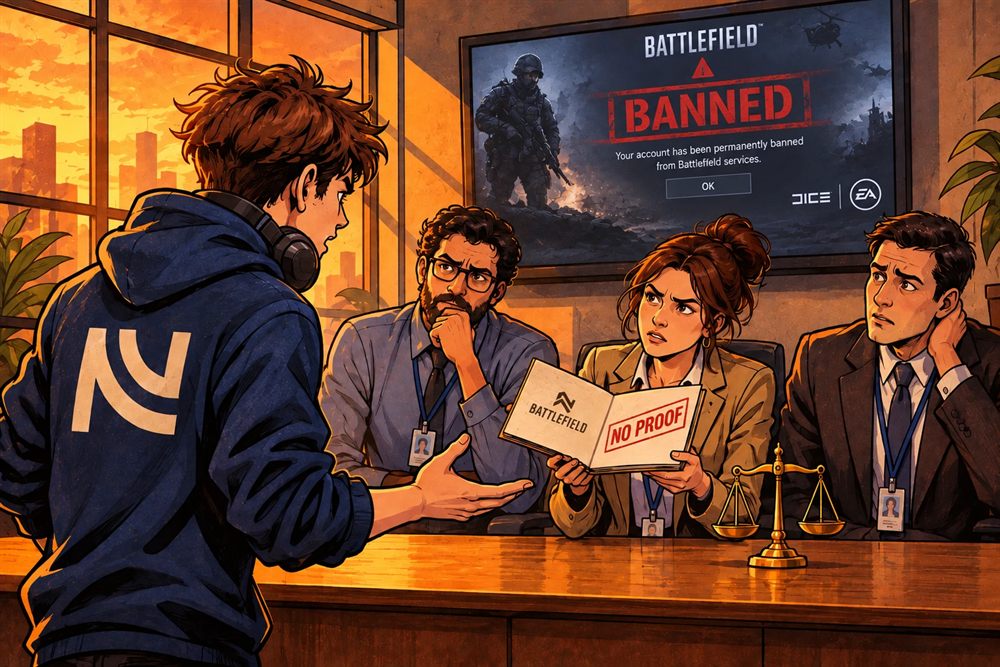
You launch the game after a few months away and instead of the menu you get a notice. Your account has been permanently suspended. You appeal and are told the decision is final, with no word on what you did or when. As far as you can tell, you have been permanently banned for no reason. That is the story told by a Brazilian Battlefield 6 player who sued Electronic Arts and announced on 8 November 2026 that he had won because, by his account, the company could not prove the cheating it accused him of. The answer to the question in the title, under Spanish and EU law, is yes. A permanent ban for cheating is valid if the company can prove the cheating, and if it cannot, you can sue the game company for banning you and get the account back.
What happened with the Battlefield 6 permanent ban
The player posts on Reddit as Rychadv. By his account, he returned to Battlefield 6 after a long break to try Season 4 and found the ban notice. He appealed through EA's channel and says he got no useful explanation. The company later told him the reason was cheating, and he replied that he would like to see them prove it.
He says he is a lawyer and therefore represented himself before a Juizado Especial Cível, the Brazilian court for low-complexity civil and consumer disputes, where filing cost him nothing. Still by his account, he submitted Windows records to show that no unauthorised software or devices had been used on his PC, and EA appeared and filed a defence without producing evidence of the cheating.
What is known about the outcome comes from the player himself and from the court document he shared, as reported by the press. The court is said to have annulled the two sanctions on the account, dated 28 July and 30 August 2026, and to have ordered EA to keep his access to the game and to everything he had bought. The company could sanction him again if it proves an actual breach. The player adds that EA has paid him in total about four times the price of the game, plus a fine, although those figures do not appear in the document he made public.
Three caveats before drawing conclusions. There is no case number and no link to the docket. EA has made no statement. And this is a decision from a Brazilian small claims court, which binds nobody in Spain. It is useful to raise the question, not to answer it.
One detail can be checked. EA's own rules page for Battlefield 6 says "We require clear evidence of cheating to ban a player". The question is what happens when someone asks to see it.
What a permanent ban is and how it differs from closing an account
Banning an account means blocking the player's access to a game or to the whole platform. Companies also call it a suspension, and it can be temporary or permanent. In legal terms it helps to separate three things that look alike and are not the same.
- A temporary suspension. It is a sanction within the contract, which stays alive.
- A closure with notice. The company stops providing the service without blaming you for anything and tells you in advance.
- A permanent ban. The company treats the contract as terminated on the spot because it considers that you breached it. It is a termination for breach, which Article 1124 of the Spanish Civil Code gives to any party that has performed its side. Closing the account of someone who really cheats is legitimate, and other players are grateful for it.
The problem with a ban is what goes with it. The account takes with it the game, years of progress and everything bought inside it, and sometimes the whole library on the platform. Whether what you buy is yours or a licence is covered in what rights you have over the games you buy online, and how that licence is tied to the account, in PS5 DRM and digital games.
In addition, Spanish consumer law requires a digital service supplied continuously to remain in conformity for the whole duration of the contract, under Article 115 ter of the consolidated consumer act. If the company cuts off access without cause, the player can demand that it be restored and, where appropriate, damages, under Articles 117 and 118.
Falsely banned for cheating: who has to prove it
This is the heart of the matter, and the rule is the same as in any other contract. If the player claims his access back and the company objects that he cheated, it is the company that is alleging a fact that extinguishes its obligation, and Article 217 of the Spanish Civil Procedure Act places the burden of proving such facts on the defendant.
The same article tells the court to bear in mind how available and how easy the evidence is for each party. The anti-cheat logs are in the company's hands. All the player can do is try to prove he did not do something, which is exactly what the law avoids asking of him.
Nor does it help if the terms of service say otherwise. Under Article 88 of the consumer act, a clause that places the burden of proof on the consumer where it should fall on the other party is unfair in every case.
Companies usually answer that they cannot explain what their system detected because that would tip off cheaters. That is an understandable reason not to post it on a forum. It is not a reason to stop proving it before a judge, because whoever terminates a contract for breach has to be able to show that breach when it is disputed.
That said, the rule cuts both ways. If the company produces the match record, the detection and the date, the ban stands and the claimant loses the case.
What Spanish courts have said about closing user accounts
Spanish courts have not yet decided any published case on the ban of a video game account. The closest judgments concern a social network and online betting sites, which are also user accounts under terms imposed by the company. They come from provincial appeal courts and from other sectors, so they guide but do not decide. Even so, they draw three rules.
- With a proven breach, a permanent closure is valid. The Provincial Court of the Balearic Islands, in its judgment 124/2020 of 26 March, upheld the permanent suspension of a Twitter account over a hate message. The clause allowed the account to be closed at any time and for any reason, or for no reason, and the user asked for it to be declared unfair. The court declined, because the closure did have a reason and because the user could also leave whenever he wished. It also noted that the sanction had been gradual, first a temporary suspension and only then the permanent one.
- Closing for no reason is valid for most courts if there is notice and the user can do the same. The Provincial Court of Málaga, in its judgment 492/2026 of 2 July, upheld the clause under which a betting site could close the user's registration at any time with fourteen days' notice. It reasons that Article 85.4 of the consumer act only treats as unfair the clauses that allow an open-ended contract to be terminated on disproportionately short notice or with no reasonable notice, and that discretionary termination is only unfair if the consumer is not given the same power. It adds that this is by far the majority view among provincial courts. It is not unanimous, because the Huesca court recalls in another judgment that it confirmed the nullity of that same clause.
- Restricting the account with no justification is unfair. The Provincial Court of Huesca, in its judgment 447/2026 of 23 September, confirmed the nullity of the clause under which an operator reserved the right to limit bets without any justification. Restricting the account without just cause, it says, creates a clear imbalance to the detriment of the consumer.
Applied to a ban, at NN Agency we read it as follows. A ban is not the Málaga case, because there is no notice, nothing is returned and the company attributes a breach to the player. It is the Balearic case if the breach is proven and the Huesca case if it is not. And there is one difference that works in the player's favour. On a betting site the user gets his balance back when the account is closed, and in a video game he loses what he has paid for.
Can a game ban you for no reason? The clauses that do not hold
With that map in hand, these are the ban clauses that the Spanish consumer act treats as unfair when the player is a consumer.
- The one that lets the company close the account on the spot and for no reason. Article 85.4 requires reasonable prior notice to end an open-ended contract, and only preserves termination for breach.
- The one that lets the company decide on its own whether you broke the rules. Article 85.3 covers clauses that reserve to the trader the power to interpret or amend the contract unilaterally. It is the consumer version of Article 1256 of the Civil Code, under which the validity and performance of a contract cannot be left to the will of one of the parties.
- The one that makes you prove that you did not cheat. That is Article 88, seen above.
- The one that lets the company keep what was paid. Article 87 treats as unfair the possibility of the trader keeping sums paid for services not yet provided when it is the trader who terminates. Think of unspent currency or a season pass bought the week before. We cover that currency in the real price of in-game virtual currencies.
The consequence is in Article 83. Unfair terms are void and treated as never written, and the contract carries on without them. The company is then left with termination for breach, which is legitimate but means proving the breach.
What you must be told when your account is banned
The Digital Services Act, which is EU Regulation 2022/2065, applies to games that store what their users write or upload, as we explain in what the Digital Services Act requires of video games. Three of its rules bear directly on bans.
- The rules, in advance. Article 14 requires the terms to explain what restrictions may be imposed and through which procedures, including algorithmic decision-making and human review, and requires them to be applied in a diligent, objective and proportionate manner.
- The reasons, in writing. Article 17 requires a clear and specific statement of reasons for anyone hit by, among other measures, the suspension or termination of their account. It has to set out the facts behind the decision, the term considered breached, whether automated means were used and how to seek redress.
- An appeal with people behind it. Article 20 requires online platforms to give you access, for at least six months from the decision, to a free internal complaint-handling system that cannot be decided solely by automated means. If the complaint fails, Article 21 lets you go to a certified out-of-court dispute settlement body, without losing the right to go to court. Micro and small enterprises are exempt from these two obligations under Article 19.
There is a nuance worth keeping in mind. Articles 17 and 20 speak of restrictions imposed because the information provided by the user is illegal or contrary to the terms. A ban for insults in chat, for an account name or for a creation uploaded to the game falls squarely within them. A ban for running cheat software is not about content, and whether the statement of reasons is due in that case is open to debate. That is why, in a cheating ban, the claim is better rested on the contract and on consumer law, with the Digital Services Act as a supporting argument.
For cheating there is another rule that does fit. An anti-cheat system processes personal data and decides automatically. Article 22 of the General Data Protection Regulation recognises the right not to be subject to a decision based solely on automated processing that significantly affects you. Where that decision is necessary to perform a contract, the company must offer at least human intervention, the chance to put your side and the chance to contest it. At NN Agency we consider that losing an account with years of purchases for good is a significant effect. Article 15 also lets you request a copy of your data and information about the logic behind those decisions, and the company has one month to reply, extendable in complex cases.
Where you can sue a game company for banning you
Many terms of service refer disputes to the courts or arbitration of another country and to foreign law. Against a consumer who lives in Spain, that does not get far.
Article 90 of the Spanish consumer act treats as unfair any arbitration other than consumer arbitration, the submission to a court other than that of the consumer's domicile and the submission to foreign law in respect of the place where the consumer contracts. And EU Regulation 1215/2012, known as Brussels I bis, allows the consumer to sue in the courts of the place where he or she is domiciled, regardless of where the other party is domiciled, provided the company directs its activities to the country where the consumer lives, under Articles 17 and
- A game sold in Spain, in euros and in Spanish will struggle to argue that it is not directed
there. Agreements made before the dispute that say otherwise do not prevail, under Article 19. The same regulation gives consumers living in other EU countries the courts of their own domicile.
Enforcing the judgment against a company with no seat in the European Union is a different matter, and can be slower and more expensive.
What to do if you are permanently banned, step by step
At NN Agency we recommend following this order. The steps are those of Spanish law, for a player who lives in Spain.
- Keep everything before you complain. The ban notice with its date, the emails, the invoices for what you bought and screenshots of your library and your balance.
- File the ban appeal and ask for the specific reason. What conduct, in which match and on what day. Do it in writing and keep the reply, even if it is automated.
- Request your data and a human review. Articles 15 and 22 of the General Data Protection Regulation allow it, and the company has one month to reply.
- Send a formal complaint with a proposal. Either access is restored or the breach is evidenced. Since 3 April 2025 a negotiated solution has to be attempted before suing in Spain, under Article 5 of Organic Law 1/2025, so it is wise to keep proof that the company received it.
- Go to the consumer authorities. The consumer office of your autonomous community can handle the complaint against the company.
- Sue if the value justifies it. The claim asks for access to be restored, for the clause the company relies on to be declared void and, if you can evidence them, for damages. Where the nullity of a standard term is sought, the case goes through the oral procedure whatever the amount and requires a lawyer and a court representative, under Articles 250, 23 and 31 of the Civil Procedure Act. You can only act without them when all you claim is a sum of no more than 2,000 euros.
Two warnings so that nobody is misled. If you did cheat and the company proves it, the ban is valid and you will normally pay the costs of the proceedings, because Article 394 of that same act imposes them on the party whose claims are all dismissed. And the Brazilian case is not a precedent in Spain, so no Spanish court is bound to follow it.
What your game's terms of service should say about bans
If you run a game with accounts, you will see this dispute from the other side. What the case and the judgments show is that a ban is defended with a clear rule and with evidence that has been kept.
- Two separate doors. One to stop providing the service without blame, with reasonable notice and a rule on what was paid for and not yet used. Another to sanction breaches. Mixing them into a single "for any reason" is what causes trouble.
- A table of conduct and graduated sanctions. What is prohibited, which sanction applies and when it is permanent. It is what Article 14 of the Digital Services Act asks for, and the Balearic court gave weight to the sanction having been gradual.
- A notice with reasons. Conduct, date, rule breached and how to appeal. Even where Article 17 does not bind you in every case, it is the safest model.
- An appeal reviewed by a person. With a response time and with real power to lift the sanction.
- The evidence, kept and ready to produce. The detection record with its date and the version of the system, retained for as long as a claim can be brought. If the anti-cheat is a third party's, the contract with that provider should oblige it to hand over that evidence for litigation.
- A realistic forum clause. A clause sending the player to litigate in another country will not stop a claim at the player's domicile.
The rest of what should be settled before launch is covered in the legal issues of creating a video game.
Frequently asked questions
▸Can you sue a game company for banning you?NPC
▸Can a game ban you for no reason?NPC
▸What does permanently banned mean?NPC
▸Can you get a permanently banned account back?NPC
▸What can you do if you are falsely banned for cheating?NPC
▸Who has to prove that I cheated?NPC
▸How do you appeal a permanent ban?NPC
▸Do I lose the games I bought if my account is banned?NPC
▸Do I need a lawyer to sue over a banned account in Spain?NPC
▸Is the Battlefield 6 player's ruling a precedent in Spain?NPC
▸What if I really did cheat?NPC
Sources
- Dexerto, Battlefield 6 player sues EA after permanent ban and wins to get account back, 8 November 2026
- Vida Extra, coverage of the Battlefield 6 permanent ban lawsuit, 9 November 2026
- WinFuture, Battlefield 6 player beats EA in court, November 2026
- EA, How to play by the rules in Battlefield 6
- Judgment of the Provincial Court of Málaga, Section 4, 492/2026 of 2 July, ECLI:ES:APMA:2026:2992, CENDOJ
- Judgment of the Provincial Court of Huesca, Section 1, 447/2026 of 23 September, ECLI:ES:APHU:2026:564, CENDOJ
- Judgment of the Provincial Court of the Balearic Islands, Section 3, 124/2020 of 26 March, ECLI:ES:APIB:2020:513, CENDOJ
- Spanish General Consumer Protection Act, Articles 82, 83, 85, 87, 88, 90, 115 ter, 117 and 118, BOE, consolidated text
- Spanish Civil Code, Articles 1124 and 1256, BOE, consolidated text
- Spanish Civil Procedure Act, Articles 23, 31, 217, 250 and 394, BOE, consolidated text
- Organic Law 1/2025, Article 5, BOE, consolidated text
- Regulation (EU) 2022/2065, Digital Services Act, Articles 14, 17, 19, 20 and 21, Official Journal of the European Union
- Regulation (EU) 2016/679, General Data Protection Regulation, Articles 12, 15 and 22, Official Journal of the European Union
- Regulation (EU) 1215/2012, Brussels I bis, Articles 17, 18 and 19, Official Journal of the European Union
At NN Agency, as video game lawyers, we help studios draft their terms of service and their sanctions system as part of ongoing legal advice and defend themselves when a player's claim arrives, and we assist professional players and content creators when the banned account is their working tool. If your game sanctions accounts and you are not sure what you could show a judge, let's talk before the first claim arrives. The first consultation is free.
Facing something similar at your studio? The first consultation is free.
Free consultation