
Are fake mobile game ads illegal? Does a not-actual-gameplay disclaimer save you?
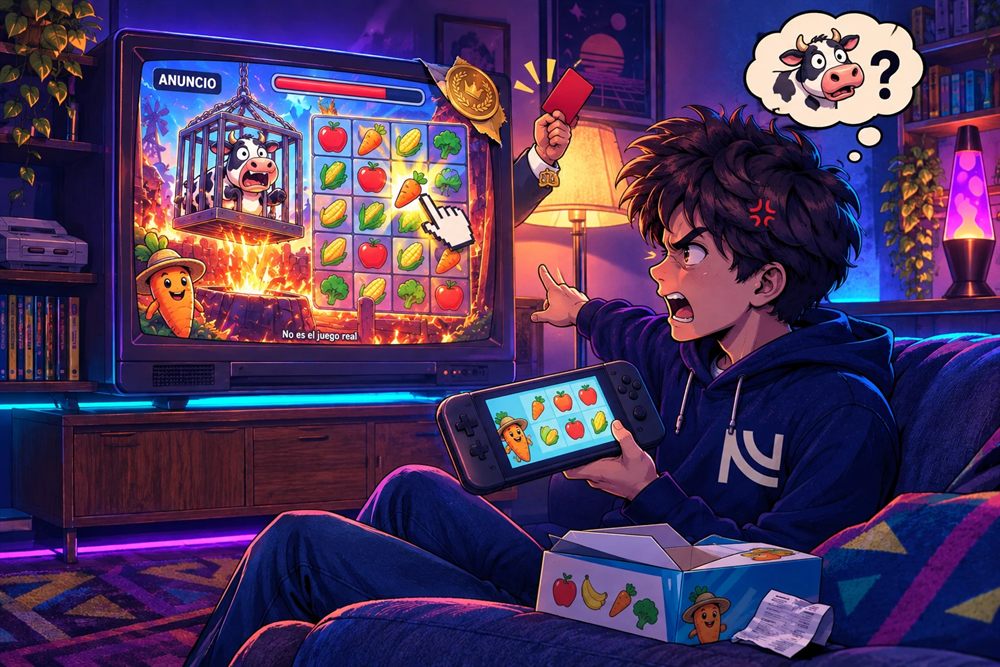
We have all seen the ad. A hand moves tiles in a rush to save a character, fails at the last second and the word FAIL appears. You download the game and it is a match-three puzzle with none of that. On 4 November 2026 the Advertising Standards Authority, the ASA, which polices advertising in the United Kingdom under the industry code, published four rulings against ads of this kind from King, Scopely, Omnilojo and Vistrex, and in the King ruling it put in writing that the "Not actual gameplay" label does not save an ad that shows the opposite. The answer to the question in the title is that yes, they are misleading advertising, under Spanish law as well, and the small-print disclaimer does not save you.
Which fake mobile game ads the ASA banned
The four rulings are part of a wider piece of work by the ASA on misleading gameplay in ads for mobile games, opened on the basis of intelligence gathered by the regulator itself. All the ads were seen on 28 April 2026.
- King, for Farm Heroes Saga. Two paid-for Facebook ads. The first showed the match-three puzzle inside a scene with falling nails and a saw moving towards a cow. None of that exists in the game. Banned. The second, without that scene, survived.
- Scopely, for Pixel Flow! Two Facebook ads. The first opened with a pipe-connecting puzzle that the game does not have. Banned. The second survived.
- Omnilojo, for Dark War Survival. Three Google ads presenting non-interactive story sequences as gameplay, with graphics well above those of the game. One also displayed two false awards. All three banned.
- Vistrex, for Idle Zombie Miner: Gold Tycoon. A Facebook ad and the game's own Google Play listing. They showed a game about driving an excavator around an open map, when the real game is an idle game and the excavator only appears in a 60-second minigame. Both banned.
The consequence is the same in every case. The ads must not appear again in that form, and each company is told to ensure its advertising does not give the impression that it shows the game, or something representative of it, when that is not the case. The ASA applied rule 3.1 of its code, on misleading advertising, and in several cases rule 3.7, which requires advertisers to be able to substantiate what they claim.
A detail for anyone who thinks this is not about them. Omnilojo is based in Singapore and Vistrex in Cyprus. Both were investigated like the rest, because their ads were seen in the United Kingdom.
Where the line is: the hand, the interface and the objective
The most useful part of these rulings is in the two ads that survived, because they show where the regulator draws the line.
In King's banned ad, the ASA looked at three things. There was a hand-shaped cursor moving the tiles, the tiles affected the rest of the scene, and there was a challenge with an ending, because the saw either reached the cow or it did not. With that, the viewer understands they are watching the game. The nails and the saw were not, in the words of the ruling, "incidental visual details", but the objective and the jeopardy around which the gameplay was presented.
In the King ad that survived, the intro was a sunrise with fruit and vegetables being picked. There was no cursor on a game board, no level objective and nothing to indicate that it could be played. Viewers understand it as theme. Then came the real puzzle and nothing else. The same happened with the second Pixel Flow! ad, where the opening scene was short and had neither a hand nor score elements.
Put practically, the ad can have a cinematic, a character or a joke. What it cannot do is present as playable something the player is not going to play. And the Vistrex case adds an important nuance. It is not enough for the scene to exist in some corner of the game. The excavator minigame did exist, but it lasted 60 seconds and appeared on completing four of the 194 mines, so it was not the core experience. Advertising the game with it was advertising a different game.
Why a not-actual-gameplay disclaimer does not help
King defended itself with the label that alternated at the bottom of the ad, "Not in-game footage" and "Not actual gameplay". It argued that viewers would understand the puzzle as the game and the rest as a creative addition to convey urgency.
The ASA replied that the wording indicated the ad was not a direct recording of gameplay, but that consumers would still understand the nails, the cow and the saw as part of the game being advertised. And it concluded that the qualification "was likely to contradict, rather than clarify" how consumers would understand the game.
This is the idea to take away. A disclaimer is there to qualify the main message of an ad, not to deny it. If the picture says the game is one thing and the small print says it is not, the picture wins. In King's second ad, the one that survived, the same label did help, because it accompanied a scene that was already understood as theme.
The awards that were not awards and the store screenshots
One of the Dark War Survival ads displayed the text "2026 Game Creative" and "2026 Survival Game" surrounded by laurels. Omnilojo explained that these referred to the game having been featured and recommended on Google Play and the App Store, and that it did not intend to suggest formal awards. The ASA answered that intention does not change the impression the ad creates. Text and laurels are understood as awards won, and the company could not show any.
The other warning is for those who look after their ads and neglect their listing. In the Vistrex case the ASA treated the image carousel on the Google Play listing as advertising. Store screenshots are advertising, and if they show an interface and gameplay that are not the game's, they have the same problem as the Facebook video.
What Spanish law says about misleading mobile game ads
The ASA is British and its rulings apply to ads seen in the United Kingdom. However, a Spanish studio advertising its game in Spain faces rules that lead to the same place.
The Unfair Competition Act. Article 5 treats as unfair, because misleading, any conduct that contains false information, or information that, even if true, by its content or presentation misleads or may mislead its recipients and may alter their economic behaviour. It has to affect one of the aspects the article lists, which include the main characteristics of the product and the results that can be expected from using it. The words "even if true", in translation, are what cover the Vistrex case. The minigame existed, but presenting it as the game misleads.
The same article lists among those aspects the awards and distinctions the trader has received, which is the laurels case. And Article 21 treats as unfair in all circumstances displaying a trust or quality mark, or an equivalent sign, without having obtained the necessary authorisation.
As for the label, Article 7 treats as misleading any information that is provided in an unclear, unintelligible or ambiguous way, or not at the right time. A small disclaimer that contradicts the picture fits there without effort.
The General Advertising Act. It declares misleading advertising unlawful in Article 3 and refers to the Unfair Competition Act for the remedies. That Act, in turn, treats all unlawful advertising as unfair.
Consumer law. Here lies a consequence that tends to go unnoticed. Article 61 of the consolidated consumer protection statute says that the content of advertising is enforceable by the consumer even if it does not appear in the contract, and that it must be taken into account when deciding whether what was supplied conforms. In other words, what the ad promises is part of what the player is entitled to receive. In a free game the individual harm is small. In a paid game, or where the player has bought in-game items attracted by what they saw, it stops being small.
At NN Agency we consider that downloading a free game is already an economic decision for these purposes, because the model lives on in-game purchases and on the advertising the player sees. We wrote about in-game purchases in whether the prices of in-game assets are accurate.
Who can bring a claim and what the penalties are
There are three fronts, and the studio can have all of them open at once.
The civil courts. The Unfair Competition Act allows a claimant to ask for a declaration of unfairness, for the advertising to stop, for the misleading information to be corrected and for damages. Anyone who takes part in the market and whose economic interests are harmed or threatened can sue, which includes the competitor whose game really is what it advertises. So can consumer associations, consumer authorities and the Public Prosecutor for the cessation action.
The consumer authorities. Using unfair commercial practices with consumers is an infringement of the consumer statute under letter m of Article 47. Fines range from 150 to 10,000 euros for minor infringements, from 10,001 to 100,000 for serious ones and from 100,001 to one million for very serious ones, and those figures can be exceeded up to several times the unlawful profit obtained, under Article 49.
Autocontrol. This is the advertising self-regulatory body in Spain. Its Jury decides complaints against ads by applying its Code of Advertising Practice, and for consumers the procedure is free. Its decisions bind member companies. For the rest they are a non-binding opinion.
And criminal liability? Article 282 of the Spanish Criminal Code punishes those who make false claims in their advertising in a way that may cause serious and manifest harm to consumers. It is designed for cases of far greater weight than the ad for a free game, so these disputes normally stay in the civil and administrative arena.
Who is liable if an agency makes the ad
Many small studios do not make their own creatives. They are produced by a user acquisition agency that tests dozens of variants and lets the best-converting one run. And if nobody is watching, the best-converting one can be the one that looks least like the game.
The law makes no distinction. Unfair competition actions can be brought against any person who has carried out or ordered the unfair conduct or cooperated in it, under Article 34 of the Unfair Competition Act. The studio that commissions the campaign is the one ordering it, so it can be sued even if it never saw the video. The ASA rulings confirm this in their own way, because all of them are addressed to the advertiser and none to whoever produced the piece.
That is why the contract with the agency has to settle three things. Who approves each creative before it is published, what it can and cannot show, and who pays if a claim arrives.
What your studio should check before launching a campaign
At NN Agency we recommend running every creative through this list before publishing it.
- Everything that looks playable must be playable. If there is a hand, a cursor, a score or an objective, the scene must be in the game and be representative of the core experience, not of a one-off minigame.
- Cinematics, without an interface. Theme intros can be used as long as they carry no elements that viewers associate with gameplay and are a minor part of the ad.
- Graphics quality, the game's own. Showing graphics far above the real ones exaggerates what the player will find.
- A disclaimer does not fix the ad. If the piece needs a label that denies it in order to be correct, the piece is wrong.
- Awards, only those you can prove. Being featured in a store is not an award. If you mention it, say exactly that, and leave the laurels out.
- The store listing counts too. Screenshots and videos on Google Play, the App Store and Steam with the real game and the real interface.
- Keep the evidence. One file per campaign with the game version and the scenes that justify each creative. The rule about being able to substantiate what you claim was applied in at least three of the four rulings.
- Clauses with the agency. Prior written approval by the studio, a ban on creatives with gameplay that does not exist and an indemnity if the agency ignores it.
If the game is aimed at minors there are additional obligations, which we review in protection of minors in video games.
Frequently asked questions
▸Are fake mobile game ads illegal?NPC
▸Why are mobile game ads misleading?NPC
▸Does a not-actual-gameplay disclaimer make the ad legal?NPC
▸What counts as false or deceptive advertising in mobile game ads?NPC
▸Do fake mobile game ads have to show the real game?NPC
▸Are app store screenshots advertising?NPC
▸What are the penalties for misleading advertising in Spain?NPC
▸Who is liable, the studio or the agency that made the ad?NPC
▸Does the ASA decision affect studios outside the UK?NPC
Sources
- ASA ruling on King.com Ltd, Farm Heroes Saga, 4 November 2026
- ASA ruling on Scopely Inc, Pixel Flow!, 4 November 2026
- ASA ruling on Omnilojo Pte Ltd, Dark War Survival, 4 November 2026
- ASA ruling on Vistrex Ltd, Idle Zombie Miner: Gold Tycoon, 4 November 2026
- Spanish Unfair Competition Act 3/1991, Articles 5, 7, 18, 21, 32, 33 and 34, BOE, consolidated text
- Spanish General Advertising Act 34/1988, Articles 3 and 6, BOE, consolidated text
- Spanish consumer protection statute, Articles 19, 47, 49 and 61, BOE, consolidated text
- Spanish Criminal Code, Article 282, BOE, consolidated text
- Autocontrol, consumer complaints before the Advertising Jury
- GamesIndustry.biz, Advertising Standards Authority bans mobile ads from King, Scopely, and others, 4 November 2026
At NN Agency, as video game lawyers, we help studios review their advertising, store listing and legal texts before launch, negotiate the contract with the marketing agency and the publisher and defend themselves when a claim arrives from a competitor or a consumer authority. If you are about to launch a campaign and are not sure what it can show, let's talk before you publish it. The first consultation is free.
Facing something similar at your studio? The first consultation is free.
Free consultation