
How enforceable are buy-out clauses in esports?
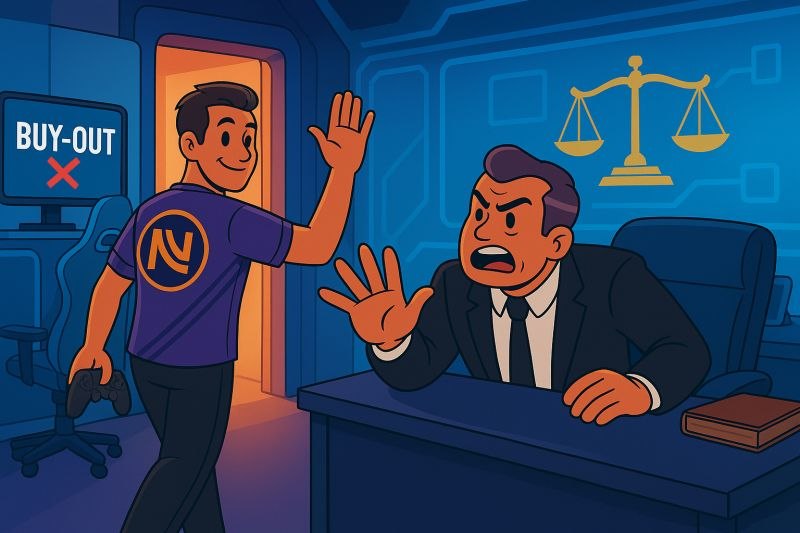
Several players have come to us asking about the validity of clauses that force them to pay compensation if they sign for another team. The short answer is uncomfortable for clubs and liberating for many players: those clauses are worth what Spanish employment law says they are worth, and the Supreme Court has spent years striking down the ones that do not meet its requirements.
Why football can and esports cannot
In professional football, release clauses exist because Royal Decree 1006/1985 exists: the special employment regime for professional athletes, whose article 16 expressly provides for termination at the athlete's will with the club entitled to an agreed indemnity. It is an exception built to measure for that sector.
In esports that foundation does not exist. Spain does not officially recognise esports as a sport, so its players do not fall under the professional athletes' regime: they are ordinary employees with contracts governed by the Workers' Statute. And under the ordinary regime there are no release clauses: there is resignation with notice, and a small set of statutory covenants that allow retaining or compensating, always under strict requirements.
The consequence is direct: when a player's contract copies football's mechanics ("if you leave early, you pay X"), that clause does not stand on its own. It stands, or falls, according to how it fits the Statute's legal figures.
What actually gets signed under the name "buy-out"
Under the commercial label "buy-out" there are really three distinct legal figures, and it pays to tell them apart because each has its own validity test:
- The retention agreement (article 21.4 of the Statute): the worker commits to staying for up to two years, and it is only available where they have received professional specialisation training at the employer's expense for specific projects. If they leave early, the club is entitled to damages actually suffered, not to an invented figure.
- The post-contractual non-compete covenant (article 21.2): it prevents signing for a competitor after the contract ends, lasts at most two years for technical staff and six months for everyone else, and requires an effective industrial or commercial interest of the club plus adequate financial compensation for the player.
- The penalty clause (articles 1152 et seq. of the Civil Code): it quantifies the indemnity for breach in advance. It is valid under freedom of contract, but courts moderate or annul it when it loses all proportion to the real damage.
In the sector's contractual reality, clubs sometimes take advantage of widespread legal unawareness and blend the three figures into a single ambiguous clause. That blend does not strengthen the clause: it weakens it, because it stacks up the requirements of all three and the scrutiny of each.
What the Workers' Statute requires
Of the three figures, the one that generates the litigation is the non-compete covenant of article 21.2, because it is the one that actually stops the player from competing. Its requirements are cumulative: if one fails, the covenant is void.
- An effective industrial or commercial interest of the club: protecting know-how, strategies, training investment. A generic interest in the player not joining a rival is not enough.
- The statutory maximum duration: six months as a general rule, two years for technical staff. It is the same limit we explained regarding studio know-how, and it operates the same way here.
- Adequate financial compensation: real consideration, proportionate to the sacrifice imposed. This is the requirement that kills the most covenants.
And a rule that surprises clubs: when the covenant is declared void for inadequate compensation, the case law tends to hold that the player walks away without having to indemnify, and depending on the case without even returning what was received. A badly drafted clause does not protect halfway: it protects nothing.
What the Supreme Court has said, case by case
The doctrine is not theoretical. These are real rulings of the Social Chamber, all on non-compete covenants under the ordinary employment regime (the one that applies to esports players):
- Judgment 1018/2021 of 18 October: a two-year non-compete compensated with 35 euros a month (1.76 % of a 1,985-euro salary) and a penalty of six months' salary for breach. Void: that amount does not compensate the restriction of a constitutional right such as work.
- Judgment of 1 December 2021: a penalty clause forcing the worker to return double the compensation received (52,000 euros). Void as disproportionate.
- Judgment of 14 December 2023: a one-year covenant void because the contract did not distinguish which part was salary and which part compensated the non-compete. The worker was moreover exempted from returning anything.
- Judgment 154/2024 of 26 January: a two-year covenant with agreed compensation of 400 euros a month (against a salary above 1,700), of which the employer only paid half. Void for inadequate compensation, with the worker released from indemnifying.
- Judgment of 12 April 2024: compensation of around 10 % of salary, held insufficient against the two-year sacrifice demanded.
The pattern is unequivocal: the Supreme Court does not question that these covenants may exist. It questions their use as a free padlock. Whoever wants to retain has to pay to retain.
The practical threshold: adequate compensation
How much is "adequate"? The law sets no figure, but the rulings yield practical guidance we use in negotiations: compensation below 15-20 % of salary is unlikely to survive judicial scrutiny, and the longer the non-compete period and the narrower the market in which the player can work, the higher you need to go.
In esports this analysis has a nuance that favours the player: careers are short and the market is extremely narrow (a professional player of a given title has a handful of teams to sign for). Barring them from competing for six months can be an enormous slice of their useful career. That context weighs in the proportionality assessment, and a judge will look at it.
If you are a club: drafting a clause that holds
If you are a club thinking of signing a new player, at NN Agency we recommend that your clauses have:
- A clear, delimited scope: exactly which activity is restricted, for what period (within the statutory maximum of six months or two years depending on the profile) and under what conditions, without ambiguities or discretionary powers for the club that prejudice the player.
- A real industrial or commercial interest: the restriction must answer a legitimate need (protecting strategies and preparation, sponsors and commercial relationships, investment in the player's training), not a bare attempt to curb their mobility.
- Serious financial compensation: an amount proportionate to the sacrifice, agreed as a concept separate from salary and actually paid. Token compensation leads straight to voidness.
- Capped penalties: the indemnity for breach must keep proportion with the damage or the real investment. The courts' approach is that the club recovers, at most, what it put in; additional punishment verges on unenforceability.
A clause like that looks less impressive on paper than a six-figure "buy-out". But it has one virtue the other lacks: it works.
If you are a player: what to check before signing (or leaving)
The other side: if you are handed a contract with an exit clause, check exactly the same things, in mirror image.
- Does the clause bar you from competing after leaving? Then it is an article 21.2 covenant and needs adequate compensation. If there is none, or it is token, it is probably void.
- Are they demanding a retention commitment? It is only available if you received specialisation training paid for by the club, capped at two years, and the indemnity for leaving early is the actual damage, not the figure they wrote in.
- Is the penalty an astronomical amount with no relation to what the club invested in you? Courts moderate or annul those.
- And the transversal advice: do not price yourself out of the market for fear of a clause that may be worthless. Before turning down an offer or paying, have a lawyer review it. The difference between a valid clause and a void one is, literally, all of the money.
Frequently asked questions
▸Do release clauses exist in esports like in football?NPC
▸Can my club stop me from signing for another team?NPC
▸What compensation is "adequate" for a non-compete?NPC
▸If the covenant is void, do I have to return what they paid me for it?NPC
▸Can the club impose a penalty for leaving early?NPC
▸I run a club. Can I not protect my investment in a player at all?NPC
▸Is an esports player a professional athlete under Spanish employment law?NPC
Sources
- Workers' Statute, Royal Legislative Decree 2/2015 (BOE)
- Royal Decree 1006/1985, special employment regime for professional athletes (BOE)
- Supreme Court judgment 1018/2021 of 18 October, Social Chamber (appeal 3769/2018)
- Supreme Court judgment 154/2024 of 26 January, Social Chamber (appeal 2349/2021)
- Spanish Civil Code, articles 1152 et seq. (BOE)
At NN Agency we advise professional players and coaches on reviewing and negotiating their contracts, clauses and transfers, and clubs and organisations on contract templates that survive a courtroom. Before paying a clause (or drafting one), talk to us: the first consultation is free.
Facing something similar at your studio? The first consultation is free.
Free consultation