
Is it legal to clone a voice with AI? The Lara Croft case
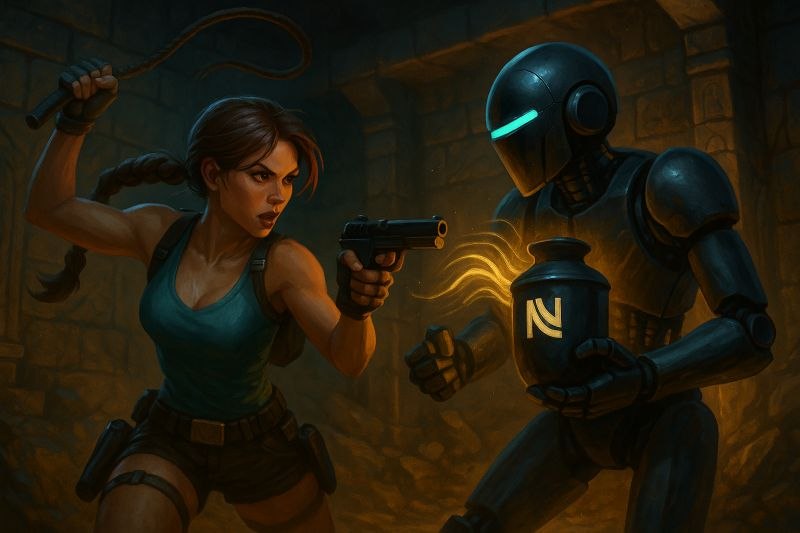
Some cases we analyse when they explode and, a year later, they remain the reference file whenever a client asks us about artificial intelligence and voices. This is one of them, and we are bringing it back for a reason: the clash between AI and dubbing starring Françoise Cadol, the French voice of Lara Croft, against Aspyr, the studio behind the Tomb Raider remasters, already has an immediate outcome and industry-wide consequences. What was then a pioneering claim is today the map of the legal limits of voice cloning.
Tomb Raider Remastered: a patch, a metallic voice and a claim
Françoise Cadol has been the French voice of Lara Croft since 1996: almost thirty years of absolute identification between actress and character. In August 2025, Aspyr released a patch for Tomb Raider IV-VI Remastered adding new dialogue lines, and it was the community that noticed something was off: the new lines sounded metallic and artificial, far from the original performance. The fans themselves alerted the actress.
The conclusion was the obvious one: the new lines had been generated with an AI replica of her voice, without her authorisation. Cadol responded with a formal demand against the Texan studio seeking nothing less than the game's withdrawal from sale until the situation was resolved. She was not just claiming money: she was claiming control over her own voice.
The immediate outcome: Aspyr backs down
The studio's answer came within weeks: an update removed all AI-generated voice content from the game, keeping the rest of the patch. Between legal pressure and the community's reaction, Aspyr chose to rectify rather than fight.
The case, moreover, grew: Brazilian actress Lene Bastos, Lara's Portuguese voice, reported suffering the same artificial replacement. The pattern was no longer an isolated incident in one language version, but a production practice (replacing regional dubbing with clones) applied to several actresses at once.
The studio's rectification does not close the legal discussion (the claim over the use already made runs its course), but it confirms what matters most to the industry: the performers' legal position was solid enough to bring the practice down without a judgment. Here is why, piece by piece.
First basis: the dubbing actor's rights against AI
As we have discussed before on this blog, a vocal performance is a protected contribution in itself: the dubbing actor is a performer, with rights of their own over the performance (in Spain, those of articles 105 et seq. of the Intellectual Property Act). Any fixation, reproduction or communication to the public of that performance requires their authorisation.
The translation to the case is direct: creating a vocal clone through AI, trained on the actress's original recordings, amounts to an unauthorised reproduction of her performances, and therefore a direct infringement of her economic rights. The clone is not born from nothing: it is born from copying what is protected. It is the same principle we analysed about AI-generated content, now seen from the raw material's side: what goes into the training also has an owner.
Second basis: the moral right and the denatured voice
But Cadol's claim did not stop at the economic side (I did not authorise, I was not paid). It added something finer: her voice had been altered, denatured and reused with a metallic timbre and no intonation. In other words, she invoked the injury to the integrity of her performance.
That is the territory of the performer's moral right (in Spain, article 113 of the Act, the performers' equivalent of article 14 protecting authors): the right to the recognition of their name over their performances and to oppose any distortion or mutilation injuring their prestige or reputation. It is a core of protection that cannot be waived or transferred, that no contract can hollow out and that does not fade with time.
The move matters for any performer: even if a studio held the economic rights over the original recordings, the moral right still stands, and a synthetic version that sounds "metallic" and "soulless" publicly associated with your name is direct ammunition for that route.
Third basis: the voice as an image right
The third pillar steps outside intellectual property: the voice is a trait of identity. In Europe it is recognised as part of the right to one's own image and personal identity; in Spain, Organic Law 1/1982 expressly treats as an unlawful intrusion the use of a person's name, voice or image without consent for advertising or commercial purposes.
Cloning a voice without consent is, legally, appropriating a trait of someone's identity. And this changes the conflict's scale: we are no longer talking only about copyright, but about fundamental rights, with potentially higher damages (the law presumes harm in every unlawful intrusion) and a devastating reputational effect for the infringing company. What the Tomb Raider case taught studios is that this front hurts more than the first one.
The added front: consumer protection
One angle almost nobody saw coming completes the siege: the product was presented as a faithful remaster of the original titles. By incorporating artificially generated voices without informing the public, its marketing can be examined through consumer law: an omission of relevant information, capable of influencing the purchasing decision, squarely within the field of misleading practices.
It is the same transparency logic that already governs other mechanics in the sector, as we covered in the 2026 legal Top 5: players are entitled to know what they are buying. Including when what they are buying is a voice.
One year on: what the case has changed
When we first analysed the case, we pointed out what it could consolidate if the claim prospered. A year later, the balance is that the industry has moved in that direction without waiting for a judgment:
- Cloned voices under the same umbrella as human performances: Aspyr's rectification (removing the content rather than defending it) is the practical acknowledgement that the unauthorised clone does not hold.
- Transparency is no longer courtesy: it is an obligation. The European labelling and information duties over AI-generated content of the Artificial Intelligence Regulation apply since August 2026: synthetic content simulating real voices or people must be flagged.
- AI clauses are now standard in the dubbing, music and performance contracts we review: express consent for training, limits on future synthetic uses, separate remuneration. The American actors' agreement after their video game strike set the template (informed consent and compensation for digital replicas), and European practice is absorbing it.
- The combined regulatory framework (intellectual property, personality rights and consumer protection) we anticipated is exactly the board on which any project with synthetic voices is negotiated today.
The Cadol case invented none of these pieces. It put them together, gave them Lara Croft's face and forced the industry to look at them all at once. That is why it remains our reference.
For studios: how to use voices (and AI) without ending up the same
The operative lesson, in five contract lines and one product line:
- Express, separate consent for AI: an assignment of rights over recordings does not authorise training clones. Ask for it separately, with separate remuneration.
- Delimited synthetic uses: which titles, which languages, which periods and with what quality control. "Forever and for everything" is the germ of the lawsuit.
- Moral rights always in sight: agree the artist's supervision of the result; a denatured voice is a claim even if all the economic paperwork is in order.
- Chain of title over the training data: which recordings feed the model and under what title you hold them, the same chain of title discipline as always.
- Transparency with the player: if there is a synthetic voice, say so. Because the regulation requires it and because, as this case proved, the community notices anyway.
Frequently asked questions
▸Who voices Lara Croft, and what happened with the AI?NPC
▸What does the law say about AI dubbing?NPC
▸Does cloning a voice with AI infringe rights even if the original dubbing was paid for?NPC
▸What is the performer's moral right and why does it matter here?NPC
▸Is the voice protected like a person's image?NPC
▸Can selling a game with undisclosed AI voices be misleading advertising?NPC
▸What should dubbing contracts include about AI today?NPC
▸I am a studio and want to use synthetic voices. How do I do it legally?NPC
Sources
- Spanish Intellectual Property Act, Royal Legislative Decree 1/1996, articles 105 et seq. and 113 (BOE)
- Organic Law 1/1982 on civil protection of honour, privacy and one's own image (BOE)
- Game Developer: French Tomb Raider actress takes legal action against Aspyr
- TheGamer: Tomb Raider 4-6 Remastered patch removes AI-generated voice content
- Regulation (EU) 2024/1689 on Artificial Intelligence (EUR-Lex)
At NN Agency we review and draft dubbing, music and performance contracts with AI clauses, protect artists' and creatives' rights against synthetic uses and defend those who have already found their voice cloned. If your project uses voices (yours or others'), let's talk before the patch: the first consultation is free.
Facing something similar at your studio? The first consultation is free.
Free consultation