
How can you know for certain how much your video game earns?
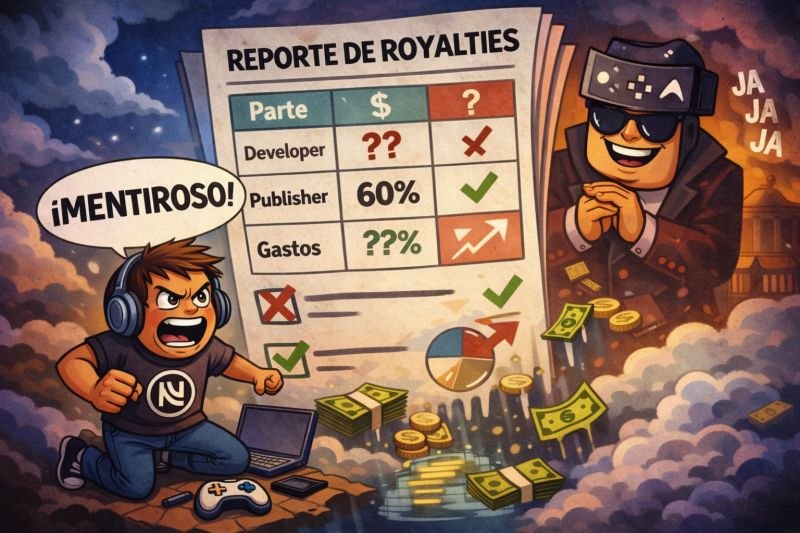
If we were asked to name one of the most frequent problems we face when representing video game studios, we would answer without hesitation: the difficulty of locating, verifying and ensuring the correct settlement of the royalties derived from the commercial exploitation of their games. Close behind comes the most obvious problem of all: business relationships with no contract, or with a contract that is practically non-existent.
What royalties actually are
It is worth starting with a clarification that changes the whole conversation. When we talk about royalties we are not referring solely to the economic return due to the rights holders, but also to the reports that make it possible to verify how, where and under what conditions the exploitation has taken place.
That second part is the one that gets neglected, and it is the one that decides whether the money that arrives is the right amount. Without verifiable reports there is no way of knowing whether the settlement is correct, and the discussion becomes a matter of trust instead of a matter of data.
That is why the publisher's obligation is not just to pay. It is to report transparently and periodically.
Every form of exploitation generates different flows
The concept of exploitation can take many forms, and each one generates distinct economic flows that must be reflected in reports of their own:
- Distribution on digital storefronts.
- Physical sale and rental through different outlets.
- Inclusion in bundles and promotions.
- Integration into subscription services, including magazines that bundle the game.
- Derivative products and commercial licences: merchandising, packs, collaborations.
- Ports and versions for other platforms.
- Advertising and integrations, where the model includes them.
Every exploitation model should have an independent report recording, as a minimum, the territory, the units and the price applied. And in practice quite a lot more is needed, as we shall see.
Why the developer is left in the dark
In practice the publisher takes on all of these tasks, so the developer depends on the information the publisher provides in order to know what their video game has actually yielded.
The limited legal specialisation that has historically characterised the industry encouraged, for years, the signing of poorly detailed contracts that gave the publisher an extremely wide margin of discretion and an almost non-existent duty of accountability. Many publishers have taken advantage of their established position to provide developers with scant and overpriced information, and developers rarely have any control over these matters.
The consequence is the one we see year after year: many studios end up not knowing how much their video games have actually generated, above all in cases where significant revenue is involved. And that situation translates into recurring disputes which, ever more frequently, end up in court.
The statutory obligation almost nobody invokes
Here is something worth knowing before sitting down to negotiate, because it changes the starting position: transparency no longer depends solely on what the contract says.
Article 75 of Royal Decree-law 24/2021 (Real Decreto-ley 24/2021), which transposed Article 19 of Directive (EU) 2019/790 into Spanish law, establishes a transparency obligation on assignees and licensees of exploitation rights: they must provide up-to-date information, at least once a year, on the exploitation of the work, the revenue generated and the remuneration due. It has applied to contracts since 7 June 2022.
In other words: there is a statutory floor of information below which the parties cannot contract, and many contracts signed since then are still drafted as if it did not exist.
That said, there is a nuance that has to be checked case by case and should not be oversold: the obligation is designed in favour of authors and performers, that is, natural persons. Where the party licensing to the publisher is a company that holds the rights through an assignment from its employees, fitting the claim requires prior analysis. By contrast, where the developer is a natural person, or where we are talking about the composers and performers of the soundtrack, the tool is there and is rarely used.
What the contract has to say
The first strategy is the obvious one, and yet it is rarely applied effectively: exact, precise contract drafting. How the reporting obligation is fulfilled, in what format and under what conditions must be detailed to the point that no gap remains that would allow the publisher to justify deficient reports.
Specifically, the obligation should contain:
A mandatory minimum report. With a defined frequency (monthly or quarterly) and a breakdown by platform, territory, currency and product identifier. And within each line: the unit type (sale, in-app purchase, subscription), commissions and taxes, refunds and chargebacks, promotions and bundles, and reconciliation with first-source reports, that is, with what the store itself reports to the publisher.
Record keeping and access. An obligation to keep the documentation supporting the reports for a set period and to provide reasonable access to it. Without this, the audit right is left without an object.
Exportable, traceable formats. The information must arrive in formats that can be analysed with your own or third-party tools, not in a two-page summary PDF. The music industry has consolidated standards for structuring sales and usage reporting; in video games there is no single equivalent, but the technical principle is the same: consistent formats reduce black boxes.
The audit clause, the one that really matters
Of all the clauses, the audit clause is the one that changes the other party's behaviour, and precisely for that reason it is the one that usually arrives drafted so as to be useless.
An audit clause works when it specifies four things:
- The scope and the timing: how much notice must be given, how often an audit may take place and over which periods.
- Who pays. Standard industry practice is for the costs to shift to the publisher when a material deviation is found, setting a specific percentage threshold. Without that shift, auditing is expensive and hardly anyone audits, which is exactly the outcome sought by whoever drafts the weak clause.
- The discrepancy threshold above which that shift, and the obligation to settle the difference, are triggered.
- Confidentiality, so that the publisher cannot object on the ground that the data is sensitive.
A clause that simply says “the developer may audit” is not an audit clause: it is a sentence.
The other two provisions worth keeping in mind
Beyond the contract, the Spanish Intellectual Property Act (Ley de Propiedad Intelectual) contains two provisions that are ammunition on this terrain:
- Remuneration proportional to the revenue of the exploitation as the general rule in assignments of rights, as opposed to lump-sum remuneration, which is only allowed in a closed list of cases.
- The revision action for inequitable remuneration, which allows the contract to be revised where there is a manifest disproportion between what was agreed and the profits obtained by the assignee.
They are not the first card to play, but they are worth keeping in mind when the contract is already signed and is a bad one, which is the situation in which most enquiries arrive.
The second route: outsourcing management
The second tool, increasingly common, is to rely on specialised rights and royalty management services. A video game combines highly heterogeneous layers of rights and revenue streams, and there an external service adds value on several fronts:
- Royalty calculation and settlement: turning reports from multiple sources into reproducible calculations per contract and per channel, with traceability and internal audit. It is especially useful where there are advances, guaranteed minimums or cross-collateralisation between titles, which is where most errors accumulate.
- Rights management: taking inventory of which rights you hold and which you have granted, with their territories, windows, platforms and exclusivities, to avoid collisions between licences.
- Reconciliation and detection of unreported uses. Two worlds need separating here. In sales and platforms the source of truth is the publisher or the store, so the main remedy is contractual: reporting and audit. In music, by contrast, identification technologies exist (acoustic fingerprinting, metadata matching, cue sheets) that make it possible to discover actual uses and sustain claims.
- Distribution of payments to many recipients, with tax compliance and traceability, which tends to be the bottleneck where there are composers, performers and collaborators.
And a distinction worth understanding: software rights and music rights do not work the same way. Code and executables are licensed by contract and are not natural candidates for global collective collection. Music, on the other hand, does have a standardised ecosystem, with international identifiers for recordings and for musical works that facilitate reporting and collection across multiple channels. If your game has an original soundtrack, there is revenue there that many studios do not even know exists.
What to do in your studio
The two strategies can be combined and, in our experience, they work best together:
- Before signing: negotiate the reporting clause with the full breakdown and the audit clause with a threshold and cost shifting. That is the moment when it costs nothing.
- If it is already signed: review exactly what it says about information, and check whether the statutory transparency obligation provides cover where the contract falls short.
- Keep everything that arrives. Every report, with its date. Reconstructing years later what was reported and when is impossible, and that record is the basis of any claim.
- Reconcile from time to time, even manually and by sampling, against the data you do control: the data from your own store page, from your analytics provider, from your campaigns.
- Review the music layer separately, because it has its own circuit.
Frequently asked questions
▸What information does the publisher have to give me about my video game's sales?NPC
▸Is there a statutory transparency obligation or does it depend on the contract?NPC
▸Can I audit my publisher?NPC
▸The contract I signed says almost nothing about reporting. Can I do anything?NPC
▸What minimum breakdown should I ask for in each report?NPC
▸Is it worth hiring an external royalty management service?NPC
▸Does my game's music generate separate revenue?NPC
▸How long should I keep the reports the publisher sends me?NPC
Sources
- Real Decreto-ley 24/2021, of 2 November — Spanish Royal Decree-law (BOE)
- Directive (EU) 2019/790 on copyright in the Digital Single Market (EUR-Lex)
- Real Decreto Legislativo 1/1996, the Spanish Intellectual Property Act (BOE)
At NN Agency we advise studios and developers on publishing, co-development and licensing contracts, negotiating agreements with publishers and investors and litigation for breach of contract. The audit clause is negotiated before signing, which is when it costs nothing.
Facing something similar in your studio? The first consultation is free.
Free consultation