
How much room do esports clubs have to claim against the owner of a private league?
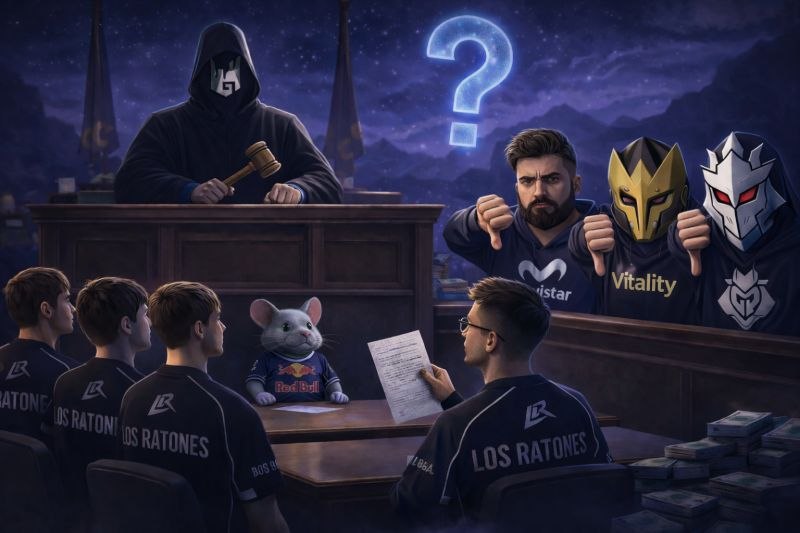
Every esports fan asked the same question when the news broke: could Los Ratones enter the LEC for free, while the league's franchises paid tens of millions for their slots back in the day? The invitation came, the team played, viewership soared and the controversy is still alive. And beneath the noise sits a legal question that matters to any club that has bought its seat in a competition: how much real room is there to claim against the owner of a private league.
The case: Los Ratones and the free slot
In October 2025, Riot Games announced a format change for the LEC, its European League of Legends competition: the 2026 season would open with a twelve-team event, adding to the ten franchises two invited teams from the regional leagues. One of those guests was Los Ratones, the team founded by streamer and caster Caedrel, which had become the year's most successful (and most talked-about) regional side.
The controversy was immediate: the LEC franchises paid tens of millions of euros for their permanent slots, and suddenly a team was competing on the same stage without paying anything, even if only for one event. Added to the protest was the fear of precedent: if a team gets invited for free today, what remains of the value of the slot I bought?
The sporting outcome matters little for our purposes. What is legally interesting is the question it left hanging: can the franchises claim anything? The answer requires distinguishing two concepts, and then walking the full path of a claim.
First key: a private league is not a federation
League of Legends and its competitive ecosystem are commercial assets exploited by Riot Games. The LEC is not a public federated competition, with access governed by sports-law rules and merit principles: it is a private league organised around a video game whose ownership and exploitation belong to the publisher, who, like any company with its own product, decides who takes part and on what terms.
That difference conditions everything. In traditional sport, the organiser sits inside a federative framework and promotion and relegation criteria it does not fully control. In esports, the owner of the game owns the league: there is no "right to compete" beyond what the contract grants. Whoever looks for the logic of federations in esports is in for disappointments; the applicable logic is that of commercial contracts between companies.
Second key: the franchise agreement and its powers
That contract exists, and it has a name: the relationship between clubs and league is usually built on franchise agreements, under which the club acquires the right to compete for as long as the agreement remains in force and its conditions are met.
These contracts do not freeze the competition, though: the organiser reserves powers to adapt it, usually drafted generously: creation of new slots, temporary invitations of teams, format changes, rulebook adjustments. They are sensible clauses (a league that cannot evolve dies), but they mark out the legal pitch: what the contract empowers is hardly ever a breach.
Los Ratones' invitation, in fact, fits that kind of power at first glance. And yet, the analysis does not end there.
The frontier: organisational decision or covert modification
The problem appears when a decision that "fits" within those powers ends up altering the agreement's economic balance. At that point, what looks like a simple organisational decision can become a covert contract modification: the organiser has not formally touched the contract, but has changed in practice the very thing the club paid for.
Think about what a franchise actually buys: not just the right to play, but a relative exclusivity (a limited number of participants), a share of the revenue split and a resellable asset (the slot). Each of those pieces can be eroded by perfectly "organisational" decisions. The frontier between the two is the line separating the two possible routes of claim.
Route one: direct breach of the contract
The cleanest route exists when the decision directly violates agreed limits: if a guest's entry exceeded the maximum number of slots allowed in a season, or skipped the approval procedures provided for, or waived the entry fee the contract contemplates for new participants.
In that scenario there is an action for breach of contract, with one nuance worth underlining: pointing at the infringement is not enough. The affected teams must prove the economic harm suffered and its direct causal link to the decision. A breach without provable damage produces indignation, not compensation.
Route two: rupture of the economic balance
The second route is subtler: the organiser's conduct formally fits the contract, but the teams argue it breaks the economic balance of their investment. The argument: I paid tens of millions for a slot in a league of ten; if the organiser can expand or invite at will, the value of what I bought dilutes.
For this route to prosper you must prove real, quantifiable damage: an actual reduction of the revenue share the league distributes, or the depreciation of the slot's value against the scenario reasonably foreseeable when the agreement was signed. It is not impossible (slots have been bought and sold, and there are market references), but it demands serious evidentiary work: valuations, comparables, projections. Aesthetic grievance does not trade.
The Achilles heel: proving damage while the league grows
And here the Los Ratones case offers the finest lesson. If the guest's entry increases the league's viewership and visibility, expanding total revenue, the net economic effect for participants can be neutral or even positive. The reduced exclusivity is offset by the growth of the total market, and with it the causal link breaks between the decision and the alleged damage.
This is no laboratory hypothesis: it is exactly what happened. Los Ratones became the event's main viewership driver, ahead of historic franchises. With those numbers on the table, a club's claim would be substantially weakened: what harm did the invitation cause, if the pie grew for everyone?
The moral for clubs is twofold. First: the moment to protect yourself is not when the guest arrives, but when negotiating the contract (clear expansion limits, mandatory entry fees, compensation mechanisms if slots are added). Second: before claiming, run the real numbers, because the organiser will.
Where this gets fought: arbitration, not court
One last piece conditions the whole strategy: even where grounds to claim exist, these contracts usually establish mechanisms that push disputes to international arbitration, final and binding. Controversies are resolved under the agreed contractual framework (frequently under foreign law and in a foreign arbitral seat), with judicial intervention limited to exceptional cases.
That is not necessarily bad (arbitration is fast and specialised), but it changes the board: confidential proceedings, high costs and arbitrators who will read the contract to the letter. One more reason for the club to stake its protection on the drafting of the agreement rather than on the later claim: the same philosophy we apply to players' contracts, one step up the chain.
Frequently asked questions
▸Can Riot invite teams into the LEC for free when franchises paid millions?NPC
▸How does an esports league differ from a traditional sports competition?NPC
▸When can a club claim over a guest team's entry?NPC
▸What damage would the club have to prove?NPC
▸Why does rising viewership weaken the claim?NPC
▸Can I take the league organiser to court?NPC
▸I run a club about to buy a slot. What should I demand in the contract?NPC
Sources
- LoL Esports: LEC 2026 Format update
- Esports Charts: LEC franchising questioned as Los Ratones drive winter viewership
- Spanish Civil Code, articles 1091 and 1258 (BOE)
At NN Agency we advise esports clubs and organisations on negotiating their franchise and league participation agreements, and league and tournament organisers on designing their rulebooks and contracts. If your club is about to buy a slot (or believes its slot is worth less than yesterday), talk to us before making a move: the first consultation is free.
Facing something similar at your studio? The first consultation is free.
Free consultation